Source check: October 26, 2026
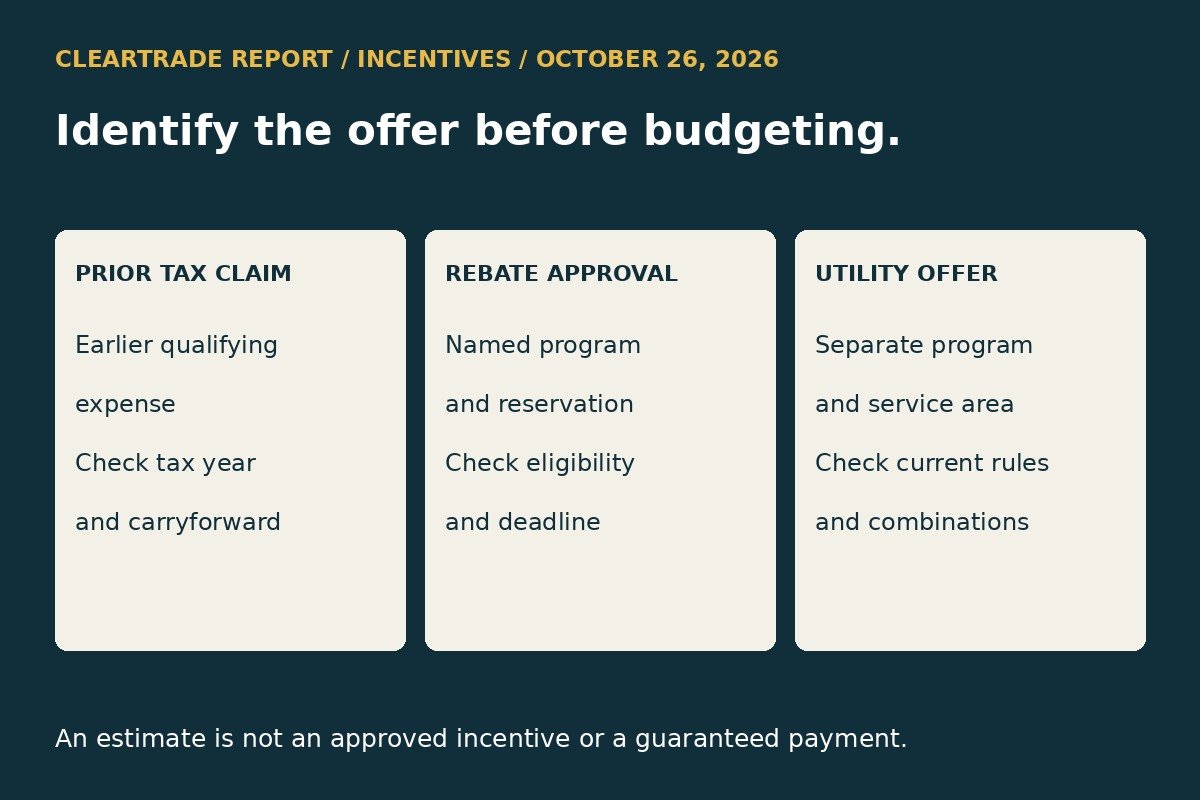
Before subtracting an incentive from an electrical or heating quote, identify exactly what the offer is: a federal tax credit, a rebate administered by a state or territory, a separate state program, or a utility offer. They have different rules and different approval processes.
For a new 2026 project, older advertising for the federal Section 25C and Section 25D home-energy credits can be misleading. The IRS’s 2025 Form 5695 instructions describe their termination after December 31, 2025. Those instructions also allow unused qualifying residential clean-energy credit to carry into 2026. A carryforward concerns an earlier qualifying expense; it does not make a new installation eligible.
This guide covers household project planning. It is not a complete inventory of business, vehicle or other federal incentives.
Separate the installation date from the filing date
An eligible 2025 project and a project first completed in 2026 are different cases even if both appear in conversations with a tax preparer during 2026.
Do not rely on a deposit date alone. In its termination FAQ, the IRS explains that paying for a Section 25D item before the deadline does not preserve eligibility when original installation is completed afterward. Special timing rules also address construction and reconstruction.
Give your tax preparer the contract, itemized invoice, completion records and prior returns. Ask which tax year and credit the advice concerns. Avoid treating a salesperson’s estimated refund as a verified tax result.
Federal rebates have a separate set of rules
DOE issued Program Notice 26-1 for HOMES and Program Notice 26-2 for state and territory HEEHR programs, both effective May 29, 2026. These notices revise program guidance; their existence does not establish that an application is available at every address.
Notice 26-2 materially changes assumptions behind older electrification promotions. Its revised approach restricts equipment upgrades to existing electric equipment being replaced by more efficient electric equipment, while retaining eligible new construction. It also addresses insulation and air sealing before heating and cooling upgrades. The notice preserves existing approved reservations under earlier guidance and provides for implementation exceptions requiring DOE approval. Ask the administrator which rules apply to your reservation; do not assume an old fuel-switching promotion remains open.
These statements concern the programs named in those notices. They should not be extended automatically to tribal, utility or separately funded state offers.
Verify the offer before treating it as money available
Use this checklist with the administrator and contractor. It is a planning worksheet, not a statement that every program requires every item.
| Check | Evidence to request | Budget treatment until resolved |
|---|---|---|
| Program identity | Official program name, administrator and current application page | Keep separate from other offers |
| Address and household eligibility | Written confirmation of the applicable service area and household rules | Do not assume eligibility from a statewide headline |
| Equipment and existing system | Approved model and replacement-condition requirements | Avoid ordering solely from a promotional list |
| Timing | Whether approval must precede purchase or installation | Wait for the required decision |
| Reservation and expiration | Reservation identifier, amount and completion deadline | Distinguish a reservation from an estimate |
| Payment recipient | Whether funds go to homeowner, contractor or another party | Show the actual cash-flow sequence |
| Combining incentives | Written explanation of permitted combinations and cost allocation | Do not add every advertised maximum |
| Scope changes | Procedure for substitutions, extra work or missed deadlines | Reconfirm before changing the job |
Save the dated rules alongside the quote. If a program page changes, that record makes the discussion more specific, although it does not itself guarantee payment.
Compare both the gross price and the conditional price
Consider a hypothetical proposal with a $12,000 gross price and a $3,000 estimated rebate. The arithmetic produces a $9,000 conditional net price. It does not establish that the homeowner qualifies or that $3,000 is reserved.
Ask for a second line showing what you would owe if the rebate is declined. Then identify who pays the contractor while an application is pending. A project that works only if an unapproved incentive arrives needs more investigation before a commitment.
Also compare the underlying scope: equipment, electrical work, permits, removal, restoration and any required prerequisite work. Two quotes with the same advertised net price may include different jobs.
Keep a project incentive file
Our recommended file contains the official rules and check date, administrator contact, eligibility decision, reservation, selected model numbers, itemized contract, completion documents, application confirmation and payment record. Include any written explanation of how multiple programs interact.
For older work, keep tax documentation separate from a new-project rebate application. Labeling each folder by program and project date helps prevent a prior credit from being mistaken for current funding.
Frequently asked questions
Can I count an old tax-credit advertisement toward a new 2026 installation?
Do not use the advertisement as proof. Check the current IRS rules for the named credit and the project’s completion dates.
Does a credit carryforward pay for my new project?
A carryforward concerns unused credit from an earlier qualifying expense. Have your tax preparer identify the eligible amount and applicable year.
Is a federally funded rebate available everywhere?
A federal program notice does not establish local application availability. Verify the administrator, service area and current application status.
Can I combine every incentive shown on my quote?
Do not assume so. Obtain the applicable programs’ combination rules and a clear allocation of the eligible project costs.
Before signing, ask the contractor to separate the gross contract price, approved incentive amounts and conditional estimates. That makes the remaining financial decision visible.
Related project planning
Compare the actual equipment scope with our heat-pump proposal checklist and heat-pump water-heater readiness guide. Neither guide establishes incentive eligibility.
See how ClearTrade verifies utility rebate sources and conditions, including why similarly named offers need separate checks.
AI tools assisted with drafting. ClearTrade Report Editorial Team checked the cited sources and edited this guide. No hands-on inspection or testing was performed.
Need a qualified professional?
Trusted Pros uses visible license-verification states and never ranks paid listings above unpaid listings.