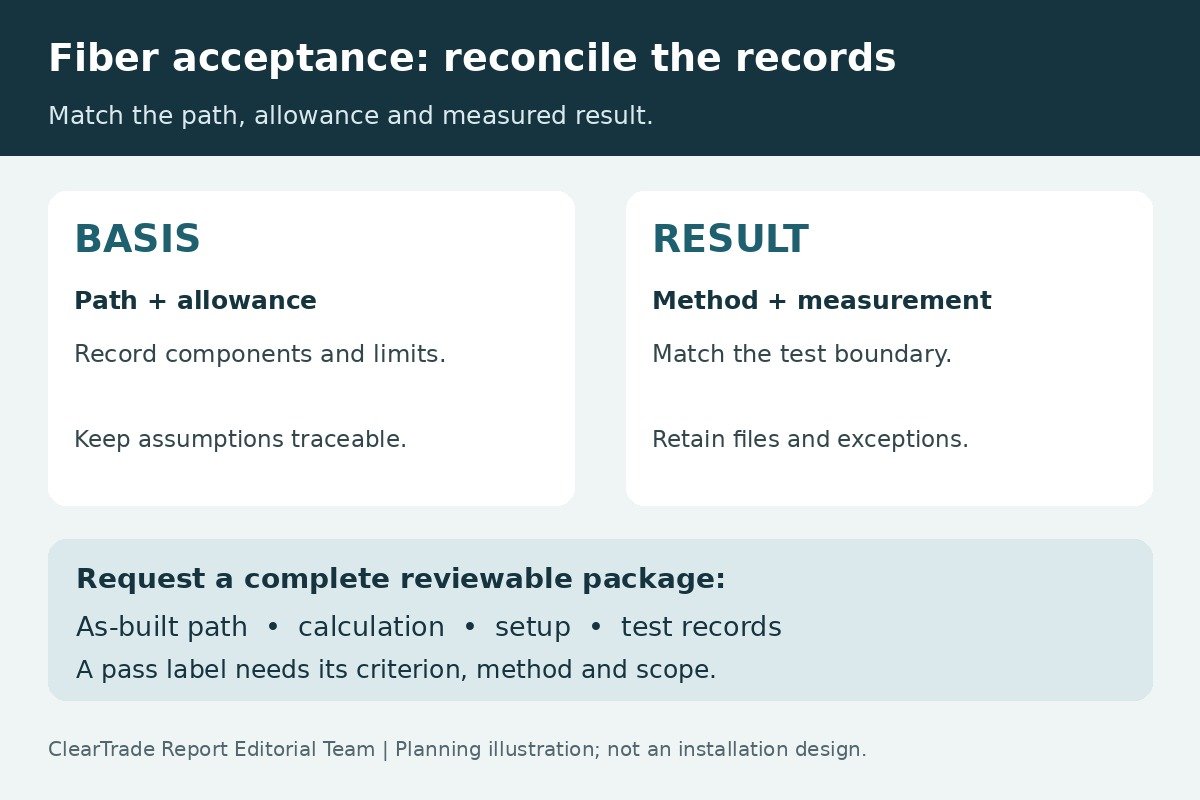
A useful fiber acceptance report connects three things: the documented cable path, the loss expected or allowed for that path, and the measured results obtained with a stated test method. A green “pass” label without the underlying limit and setup does not explain what the owner is accepting.
Start by asking whether the report addresses installation quality, support for the intended network application, or both. Those questions overlap, but they are not identical. This guide offers a document-review workflow for owners and low-voltage contractors; it does not certify a link, select optics or provide a field-test procedure. ClearTrade Report Editorial Team checked the primary sources October 27, 2026. No hands-on testing or outside professional review was performed.
Keep the budget, measurement and application limit separate
FOA’s loss-budget guidance describes estimating cable-plant loss from the fiber, connections, splices and relevant passive components. It compares that estimate with measured insertion loss. A component-based estimate describes the installed path; an optical application also has its own limits.
Ask the report to name each value rather than call every number “the budget.” Is it an expected component sum, a contractual acceptance threshold, an application-specific channel limit or a measured result? Have the provider identify the source and revision behind the threshold used for pass/fail.
An intentionally generous acceptance threshold may hide the difference between expected and measured performance. Conversely, an unusually strict number may have been entered without accounting for the specified method. The owner should request the rationale, not substitute a preferred number after seeing the results.
Keep the approved specification and any authorized changes with the test record. If the parties revise the criterion, retain the old criterion and explain the change. A threshold change is not the same as repairing and retesting a link.
Match every result to the installed path
Before comparing numbers, verify the identities. Ask for the cable identifier, fiber identifier, endpoint names and the route or panel records that connect them. Make sure “A to B” means the same endpoints in the drawings, native test files and summary report.
Have the contractor distinguish the installed cable section from the complete operational channel. Which patch cords, cross-connects, splices or passive devices are inside the tested boundary? Which items will be added when equipment is connected? A number for one boundary should not silently be represented as a result for another.
Request the installed length and the basis for it. If a length is an instrument result, retain that fact and its settings rather than presenting it as an independently surveyed route measurement. Ask how extra connections or route changes were incorporated into the final documentation and loss calculation.
Our single-mode versus multimode comparison explains media and optic planning. This article begins at the acceptance record: the report must identify the actual fiber and intended use before its numbers can be interpreted.
Make the arithmetic auditable
For a component estimate, request the length, the attenuation allowance per unit length, the counted connections and splices, and the allowances applied to them. Identify the wavelength and the source of each assumption. Have the provider explain whether “connection” means a mated connector pair and how the endpoints were counted.
As a hypothetical arithmetic example only, suppose a worksheet assigns 0.20 dB to the fiber, 0.60 dB to counted connections and 0.20 dB to splices. The sum is 1.00 dB. Those invented inputs are not recommended component allowances or a pass threshold. They show why the worksheet should reveal what was included instead of showing only a total.
If that hypothetical report then measures 0.80 dB against an agreed 1.00 dB limit, the arithmetic difference is 0.20 dB. That difference alone does not establish adequate engineering margin, measurement confidence or suitability for a particular application. Ask how the project’s decision rule addresses those questions.
Do not import a generic internet allowance into an existing contract or treat a manufacturer’s best-case figure as a guaranteed installed result. Ask the responsible designer or reviewer to reconcile the actual specification, method and equipment requirements.
Check what the reference method includes
The reference setup affects which connections contribute to the reported loss. FOA explains that one-, two- and three-cable references account for endpoint connections differently. The calculation and measurement therefore need compatible boundaries; otherwise an apparently favorable result may be compared with the wrong allowance.
Fluke Networks’ February 24, 2026 reference-method explanation describes optical loss testing with a source and power meter and the role of test reference cords. It also discusses cord condition and multimode launch conditions as influences on the measurement. We use that guidance to identify questions, not to prescribe a setup for every connector system.
Request the recorded reference method, test wavelengths, directions, instrument and module identification, applicable setup information and reference-cord verification evidence. Ask whether the submitted files retain the test-limit selection and any relevant settings. For multimode testing, have the provider identify how the required launch conditions were addressed.
Do not treat setting a reference as proof of the instrument’s current calibration status. Ask for the equipment information required by the project and the applicable manufacturer instructions. This article has not reviewed or operated the tester used on your job.
Read insertion-loss and OTDR results for their different purposes
An optical loss test set, or a light source and power meter, measures end-to-end insertion loss. An optical time-domain reflectometer, or OTDR, provides an indirect view useful for locating and assessing events along a fiber. FOA’s guidance cautions that the methods do not necessarily produce interchangeable loss results.
If a package contains only traces, ask whether the required insertion-loss evidence is also included. If it contains only an insertion-loss summary, ask whether the project also requires event-level records. Specify the deliverables from the project requirements rather than assuming that the more elaborate-looking instrument replaces every other test.
For an OTDR record, request the native trace and its interpretation, not just a cropped screenshot. Have the provider identify the tested direction, setup and any events it could not resolve separately. This guide does not assign splice grades, interpret a particular trace or provide a universal OTDR pass limit.
Keep inspection and polarity records distinguishable from attenuation results. A loss number does not, by itself, demonstrate that every fiber follows the intended transmit-to-receive mapping or that all other specified checks were completed.
Reconcile optics without turning power figures into a guarantee
Cisco’s 10GBASE SFP+ data sheet, updated October 6, 2026, separately presents media/reach information and optical transmit/receive specifications. It also includes model-specific conditions. This illustrates why a report should identify the exact optics and applicable requirements rather than rely on a generic speed or distance label.
Ask the designer which channel requirements and other constraints apply to the intended application. A subtraction using transmitter and receiver figures should not be represented as permission to ignore other documented limits. Have any margin or additional allowances explained and tied to the design basis.
Where the equipment is not yet selected, state that limitation. Cable-plant acceptance under a documented specification is not a promise to support every future optic, wavelength or network speed. Retain the intended upgrade assumptions as assumptions, with responsibility for checking them before equipment changes.
Use a reconciliation worksheet
This original editorial worksheet organizes a review conversation. It does not replace the agreed project specification or technical sign-off.
| Review item | Record to request | Question before acceptance |
|---|---|---|
| Link identity | Fiber IDs, endpoints and as-built path | Do the drawing, labels and test files describe the same link? |
| Calculated allowance | Component counts, length, wavelength and assumption sources | Can another reviewer reproduce what was counted? |
| Test setup | Method, reference, instruments and applicable settings | Does the measurement cover the same boundary as the limit? |
| Results | Native files, summary, limits and exceptions | What passed, what failed and what was not tested? |
| Application fit | Exact intended optics and channel requirements | What use is supported, and what remains conditional? |
Close exceptions with evidence
FOA’s installation-deliverables guidance emphasizes understandable documentation, test data and review by someone familiar with the project. It also explains that estimated budgets and measurements have uncertainty. That supports documenting a review decision rather than treating every small numerical difference as self-explanatory.
For a borderline, failed or inconsistent result, record the question, responsible reviewer and required next action. Ask whether the issue concerns the installation, test setup, identification, criterion or missing evidence. Do not resolve it by deleting the unfavorable file or comparing measurements taken under unexplained different conditions.
Retain the original result, corrective explanation and replacement result with their dates and identifiers. Make it clear which revision is accepted and which entries remain open. Keep both an accessible summary and native files the owner is authorized to retain, together with the means to view them. Receiving a folder and completing a technical review are separate milestones.
Keep the accepted test data connected to the physical labels and endpoint records. Our structured cabling handover checklist explains port maps, native files, warranty receipts and revision history for the owner’s complete package.
Sources and scope
Primary references checked October 27, 2026: FOA loss-budget and installation-deliverables guidance; Fluke Networks’ reference-method explanation dated February 24, 2026; Cisco’s 10GBASE SFP+ data sheet updated October 6, 2026. No paid standard was reviewed, no named link was tested, and no product recommendation, warranty acceptance or network-performance guarantee is made. Numerical examples are original invented arithmetic, not design criteria.
Frequently asked questions
Is a loss budget the same as a measured result?
No. The budget or allowance states a calculation or criterion; the measurement records a result from a particular setup. Compare them only after confirming compatible boundaries and methods.
Can an OTDR trace replace every insertion-loss result?
Do not assume so. The methods serve different purposes. Request the insertion-loss and event-level evidence required by the project, with native files and the applicable setup records.
Does passing a cable test guarantee support for any optic?
No. Identify the intended application, exact optics and applicable channel requirements. An accepted cable-plant record does not establish compatibility with every future equipment choice.
What should happen to a failed result after retesting?
Retain it with the corrective explanation and the replacement result. Record which revision was accepted, who reviewed it and which exceptions remain unresolved.
AI tools assisted with drafting. ClearTrade Report Editorial Team checked the cited sources and edited this guide. No hands-on inspection or testing was performed.
Need a qualified professional?
Trusted Pros uses visible license-verification states and never ranks paid listings above unpaid listings.