On this page
- What the inventory describes
- Why a record may remain unknown
- Questions for your utility
- Keep identification and replacement separate
- A water softener is a separate decision from what your service line is made of. If you are also sizing a softener, see our guide to water softener sizing by hardness, capacity and regeneration water.Frequently asked questions
- Sources
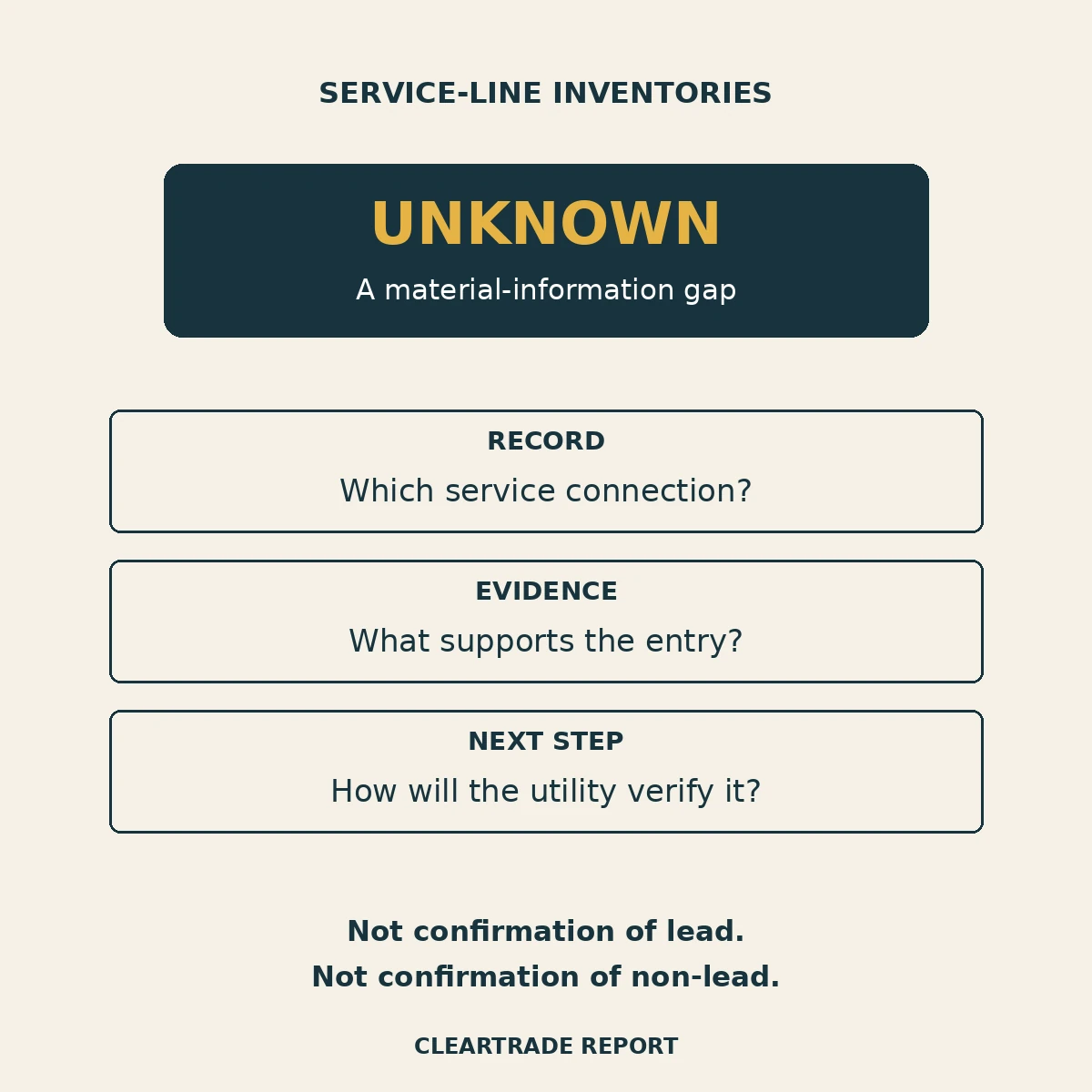
An “unknown” entry in a water utility’s service-line inventory means the material has not been classified as lead, galvanized requiring replacement, or non-lead. It is not confirmation of a lead pipe—and it is not a finding that the line is non-lead.
EPA’s August 2026 inventory tips explain how water systems can investigate those gaps using records and other evidence. For a property owner, the useful next step is to understand the record behind the label and the utility’s process for resolving it.
What the inventory describes
A service line connects a water main to the plumbing in a home or other building. EPA notes that identification needs to account for lines on both public and private property.
That is a different question from the condition of every pipe, faucet and fixture inside the building. EPA identifies interior fixtures as potential sources of lead too. The practical implication: a service-line classification should not be treated as a whole-building water-quality test.
Start by confirming that you have the inventory entry for the correct address and service connection. Save the entry and the date you accessed it; keep any utility notice with the property’s plumbing records.
Why a record may remain unknown
EPA’s August tips identify construction and plumbing codes, water-system records and distribution-system inspection records as information sources. The document also describes other evidence-based methods, including predictive modeling, subject to approval by the drinking-water oversight agency.
Consequently, a material classification does not necessarily mean someone excavated that particular property. Ask what evidence supports the entry and what validation applies. Avoid substituting a neighbor’s record or a general assumption about the neighborhood for the utility’s determination.
EPA’s identification overview notes that incomplete records and a long history of repairs make locating lead service lines difficult. A recent interior renovation, by itself, does not tell an owner what records exist for the buried service connection.
Questions for your utility
Use these questions when the inventory is unclear or a notice raises concerns:
- Which connection does this entry cover? Confirm the address, service identifier and whether there are multiple connections.
- What portions are documented? Ask how the record addresses the line on public and private property and whether either portion remains unresolved.
- What supports the classification? Request the record type, observation or approved method used, together with its date.
- What is the next verification step? Ask who coordinates it, whether access is needed and how an owner will receive an updated result.
- How do I submit a correction? Find out how to provide existing replacement invoices, permits or other records and how the utility reviews them.
These are documentation questions, not instructions to excavate, scratch-test, disconnect or disturb a service line. Coordinate physical investigation with the water utility and the appropriate qualified professional.
Keep identification and replacement separate
A material entry helps establish what is known. It does not, by itself, answer who will perform work, who pays, when access is needed or what restoration is included.
If the utility proposes investigation or replacement, request a written scope. Confirm the portions involved, responsibility for coordination, access arrangements, restoration and the instructions occupants should follow. Ask about available assistance directly; do not assume that an inventory label guarantees funding or a particular replacement date.
For questions about drinking-water exposure, sampling or precautions while a line is being investigated, use the utility’s current instructions and your drinking-water or public-health authority. This article does not infer the safety of a property’s tap water from an inventory label.
Related reading: keeping building-system records.
For work inside the building, our PEX, copper and CPVC repipe comparison provides a separate proposal record for assemblies, routes, retained components and restoration. An interior repipe does not establish the material of the service connection.
A water softener is a separate decision from what your service line is made of. If you are also sizing a softener, see our guide to water softener sizing by hardness, capacity and regeneration water.
Frequently asked questions
Does “unknown” mean my service line is lead?
No. It means the material has not been classified as lead, galvanized requiring replacement, or non-lead. Ask the utility how it will resolve the uncertainty.
Does “non-lead” certify all the plumbing in my building?
No. A service-line inventory describes the service connection. It is not a test of every interior pipe, faucet, fixture or water sample.
Must every classification come from excavation at that address?
No. EPA’s inventory tips describe records and other evidence-based approaches, including approved modeling. Ask which method supports your entry.
Can I correct an entry with an old replacement invoice?
You can ask the utility how to submit supporting records. The utility must evaluate the evidence; an invoice does not automatically change the inventory.
Sources
Sources inspected October 26, 2026.
- EPA: LCRI Service Line Inventories—Tips, August 2026, EPA 815-F-25-005 — definition of unknown and evidence-based inventory methods. This informational document does not replace the governing regulations.
- EPA: Getting Started with Lead Service Line Identification and Replacement — service-line definition, public/private identification and recordkeeping context.
- EPA: Lead Service Lines — inventory purpose and plumbing-source context.
Need a qualified professional?
Trusted Pros uses visible license-verification states and never ranks paid listings above unpaid listings.