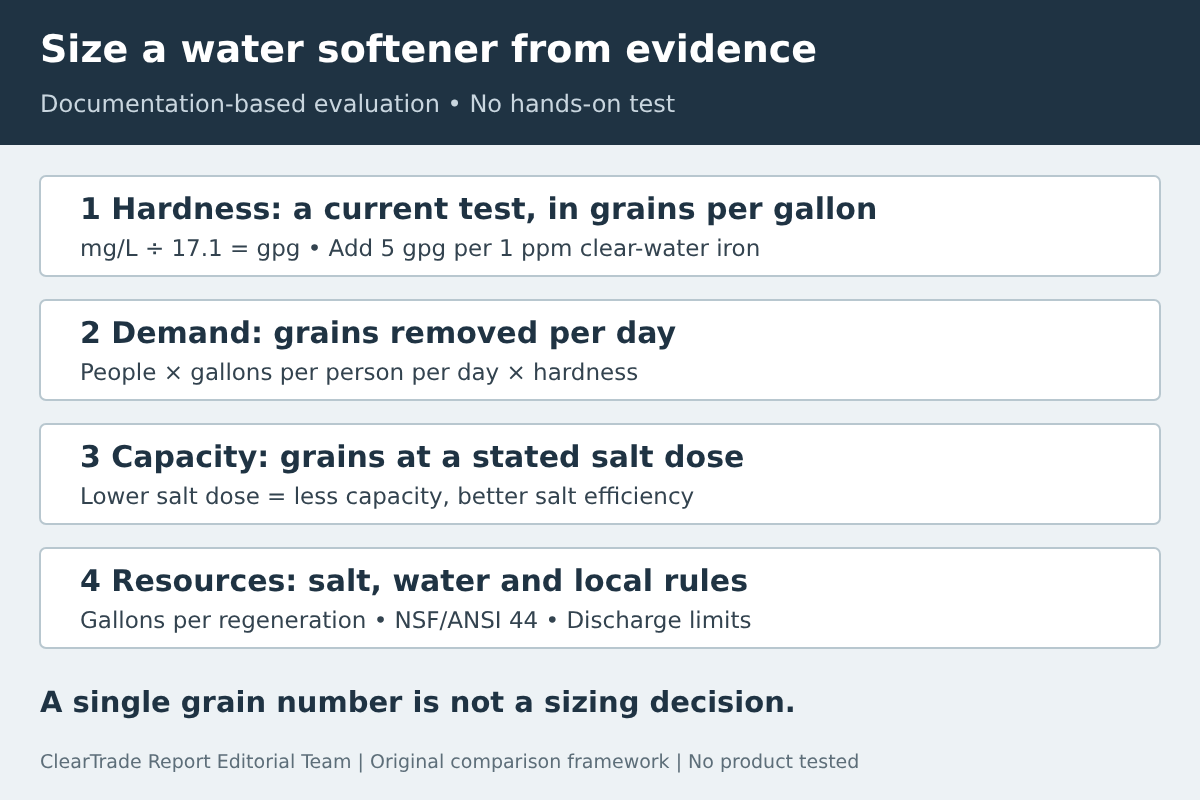
Size a water softener from three pieces of evidence: a current hardness test (plus iron, if present), the water your household actually uses, and the softener’s capacity at a stated salt dose. Then compare how much water each regeneration uses, whether the model is certified to NSF/ANSI 44, and what your local rules allow. A single grain number on the box does not settle any of those questions.
Evidence label: Specification/documentation-based evaluation. ClearTrade Report Editorial Team checked government, standards-body and manufacturer documents on November 1, 2026. No hands-on testing or outside professional review was performed. The named softeners below are documentation examples, not recommended purchases or a ranked shortlist. No product was supplied for this article, and this guide contains no affiliate links.
Start with a current water test
A softener removes hardness, so the starting point is a measured hardness value for the water entering the house, not a guess or a regional map. Private well owners usually need their own test; utility customers can often find hardness in the utility’s water quality report, but a home test still confirms what reaches the softener.
Ask the test to report total hardness and iron. The Minnesota Department of Health notes that hardness “is caused primarily by calcium and magnesium ions, but also by iron and manganese ions present in the water,” and that “water softeners can typically remove up to about 3 mg/L of iron.” Higher iron levels, or iron that is not in the dissolved (clear-water) form, may need separate treatment; check the softener manual’s iron limit before buying.
The test also tells you whether softening is needed at all. USGS classifies water from 0 to 60 mg/L as calcium carbonate as soft, 61 to 120 mg/L as moderately hard, 121 to 180 mg/L as hard and more than 180 mg/L as very hard. EPA’s WaterSense softener guide says water above 120 mg/L (7 gpg) is generally considered hard and that softeners are often recommended above 180 mg/L or 10 gpg. EPA’s WaterSense technical sheet for homes advises against installing softeners when hardness levels do not indicate a need.
Convert hardness to grains per gallon, then add iron
Softener capacity is published in grains, so convert a lab result in mg/L (or ppm) to grains per gallon (gpg). The Minnesota Department of Health’s well owner’s handbook states that one grain per gallon equals 17.1 mg/L. A test result of 171 mg/L is therefore 10 gpg.
If the water contains clear-water (ferrous) iron, the manufacturers we checked tell owners to raise the hardness setting. Whirlpool’s WHES40/WHES44 manual says to add 5 grains to the hardness setting for every 1 ppm of ferrous iron, and the Morton MSD45E and GE GXSF30V manuals give the same add-5-per-ppm instruction. We did not find a primary source giving a manganese adjustment, so ask the manufacturer if your test shows manganese.
Estimate the grains removed each day
Daily demand is people times gallons per person per day times hardness in gpg. Penn State Extension’s worked example uses 75 gallons per person per day for four people at 10 gpg, which gives 3,000 grains per day, and notes that a softener with 20,000 grains of capacity would then regenerate about every 6 to 7 days.
The gallons-per-person figure matters as much as the hardness. The Water Quality Association’s softener guide suggests sizing from a typical four-person household using about 200 gallons per day, which is lower than the Penn State example. If you have water bills or a meter reading, use your own daily use instead of either assumption.
Bigger is not automatically safer. EPA’s guide says softeners are sized by grain capacity and that oversizing leads to inefficient use of water. Size for the daily load and a sensible regeneration interval, then compare models on how efficiently they deliver that capacity.
Read capacity as grains at a stated salt dose
A softener’s capacity changes with the amount of salt used per regeneration, so a single “40,000-grain” label hides a range. Whirlpool’s manual lists the WHES40 at 17,300 grains with 3.4 lb of salt, 31,600 grains with 9.0 lb and 40,000 grains with 15.5 lb. The headline number is the high-salt setting.
Salt efficiency, grains removed per pound of salt, shows the trade-off. Whirlpool lists the WHES40 at 5,094 grains per pound at the 3.4 lb setting. Dividing its own figures, the 15.5 lb setting delivers about 2,580 grains per pound: a little more than twice the capacity for about four and a half times the salt. When you compare models, compare capacity at a similar salt dose, not the largest number each brand prints.
Count the water each regeneration uses
Every regeneration sends rinse and brine water to drain. Manufacturers that publish it usually express it as gallons per 1,000 grains removed and as gallons per regeneration. Whirlpool lists 3.0 gallons per 1,000 grains for the WHES40 at its minimum salt dose and 37.1 gallons per regeneration at its highest salt setting; GE lists 2.8 gallons per 1,000 grains for the GXSF30V and 35.5 gallons at its highest setting; Morton lists 4.3 gallons per 1,000 grains for the MSD45E. Whirlpool notes that its efficiency rating is valid only at the minimum salt dose and rated service flow, so do not apply the per-1,000-grain figures to high-salt settings.
Federal efficiency criteria give a reference point. EPA’s WaterSense guide says an efficient softener uses 5 gallons or less per 1,000 grains of hardness removed and has a salt efficiency greater than 3,350 grains per pound. The DOE/PNNL Building America Solution Center adds that time-clock regeneration does not qualify for the efficiency rating, and EPA recommends demand-initiated regeneration (DIR), which regenerates only when needed, over time-initiated systems.
Check NSF/ANSI 44 certification and the efficiency claim
NSF/ANSI 44 is the standard for residential cation exchange water softeners. NSF says it covers hardness reduction, material safety, structural integrity, pressure drop, softening capacity and rinse effectiveness, accuracy of the brine system, and accuracy of the information provided to users. EPA’s guide recommends choosing a softener certified to it.
Do not rely on a logo alone. Search the NSF listings for the exact model under “Cation Exchange Water Softeners (NSF 44)” and check which claims are listed, including any efficiency rating. The Whirlpool and Morton manuals we checked state certification by NSF International against NSF/ANSI 44 for hardness reduction and efficiency. Other certifiers also list products; the Water Quality Association keeps a searchable product listing at wqa.org/find-products.
Check local rules before choosing a model
Softener brine discharge is regulated in some places. EPA’s guide notes that some local jurisdictions prohibit installing and using these systems. In California, the City of Riverside’s residential softener guidelines, citing the state Health and Safety Code, require demand-controlled regeneration, a salt efficiency of at least 4,000 grains per pound certified by an independent rating organization, and discharge to the sanitary sewer with a minimum 1-inch air gap. GE’s GXSF30V manual tells California owners to turn its salt efficiency feature on.
Septic systems raise separate questions. Connecticut’s Department of Public Health says backwashing softener wastewater to a septic system is specifically prohibited there. Ask your local health department or building department before installing a softener on a septic system.
Hardware limits matter too. Check the manual’s maximum hardness and iron, service flow rate and pressure drop, and the operating pressure range against your house. Whirlpool, for example, lists 20 to 125 psi for the WHES40 and WHES44, and notes that Wisconsin requires additional treatment where clear-water iron exceeds 5 ppm.
Use a specification record before comparing prices
The table below lines up three documented examples from their owner’s manuals. These are documentation examples, not recommended purchases; check the current manual for the exact model you plan to buy.
| Model (documentation example) | Capacity at stated salt dose | Salt efficiency (at minimum salt dose) | Regeneration water | Flow and pressure drop | Max hardness / clear-water iron |
|---|---|---|---|---|---|
| Whirlpool WHES40 | 17,300 gr @ 3.4 lb; 31,600 @ 9.0 lb; 40,000 @ 15.5 lb | 5,094 gr/lb @ 3.4 lb | 3.0 gal per 1,000 gr at minimum salt dose; 37.1 gal at highest setting | 7.6 gpm; 14.7 psi | 125 gpg / 10 ppm |
| GE GXSF30V | 11,900 gr @ 2.5 lb; 25,300 @ 7.9 lb; 30,100 @ 13.3 lb | 4,770 gr/lb @ 2.5 lb | 2.8 gal per 1,000 gr at minimum salt dose; 35.5 gal at highest setting | 7.5 gpm; 13.4 psi | 95 gpg / 8 ppm |
| Morton MSD45E | 13,233 gr @ 2.6 lb; 35,700 @ 9.9 lb; 45,400 @ 17.2 lb | 5,089 gr/lb @ 2.6 lb | 4.3 gal per 1,000 gr at minimum salt dose | 10.0 gpm; 11.2 psi | 120 gpg / 12 ppm |
Before buying, add your own row: measured hardness in gpg, iron adjustment, household gallons per day, target days between regenerations and any local discharge rule. A model that cannot meet those numbers at a moderate salt setting is the wrong size, whatever its headline capacity.
Choosing a softener is a separate question from what is in your service line. If you are also unsure what your water service pipe is made of, see our guide to lead service line inventories and “unknown” listings.
Know the limits of this guide
Evidence label: specification and documentation-based evaluation. ClearTrade Report Editorial Team checked the sources below on November 1, 2026. We did not test any softener or water supply. Manuals and listings change; the GE manual’s Spanish section shows slightly different capacity figures from its English section, and we used the English figures. A softener does not treat bacteria, nitrate, lead or other contaminants; ask a certified lab and a qualified water treatment professional about water quality beyond hardness and iron.
Primary references checked November 1, 2026: USGS Water Science School, “Hardness of Water”; Minnesota Department of Health, Well Owner’s Handbook; Penn State Extension, “Water Softening”; EPA WaterSense water softener guide and WaterSense technical sheet on water softeners; DOE/PNNL Building America Solution Center, water softeners; NSF, NSF/ANSI 44 technical requirements and NSF certified product listings; Water Quality Association, “Getting Smart with Softeners”; Connecticut Department of Public Health, hard water and softeners fact sheet (November 2023); City of Riverside, Residential Water Softener Guidelines; Whirlpool WHES40/WHES44 owner’s manual (W11484759 Rev B); GE GXSF30V owner’s manual; Morton MSD45E owner’s manual.
If your concern is a specific contaminant at one tap rather than hardness, see our guide to matching a point-of-use water filter to its exact certified reduction claim.
Frequently asked questions
How do I convert a water test in mg/L to grains per gallon?
Divide by 17.1. The Minnesota Department of Health states that one grain per gallon equals 17.1 mg/L, so 171 mg/L of hardness is 10 grains per gallon.
How do I estimate what size water softener I need?
Multiply the number of people by gallons used per person per day and by hardness in grains per gallon to get grains per day. Penn State Extension’s example of four people using 75 gallons each at 10 gpg gives 3,000 grains per day. Then choose a capacity, at a moderate salt dose, that covers several days between regenerations.
Why does a softener’s capacity change with the salt setting?
Manufacturers rate capacity at specific salt doses. Whirlpool lists the WHES40 at 17,300 grains with 3.4 lb of salt and 40,000 grains with 15.5 lb. Lower salt doses give less capacity but more grains removed per pound of salt.
What should I check besides capacity?
Check water used per regeneration, salt efficiency, whether regeneration is demand-initiated, NSF/ANSI 44 certification of the exact model, the manual’s iron and hardness limits, and local rules on softener discharge, including septic systems.
Disclaimer: This guide is general information based on government, standards-body and manufacturer documentation, not professional, plumbing, water-treatment or purchasing advice for a specific home. Follow the manufacturer’s instructions and local codes, and use a qualified professional and a certified laboratory where water quality could affect health. AI tools assisted with drafting. ClearTrade Report Editorial Team checked the cited sources and edited this guide. No hands-on testing was performed.
Need a qualified professional?
Trusted Pros uses visible license-verification states and never ranks paid listings above unpaid listings.