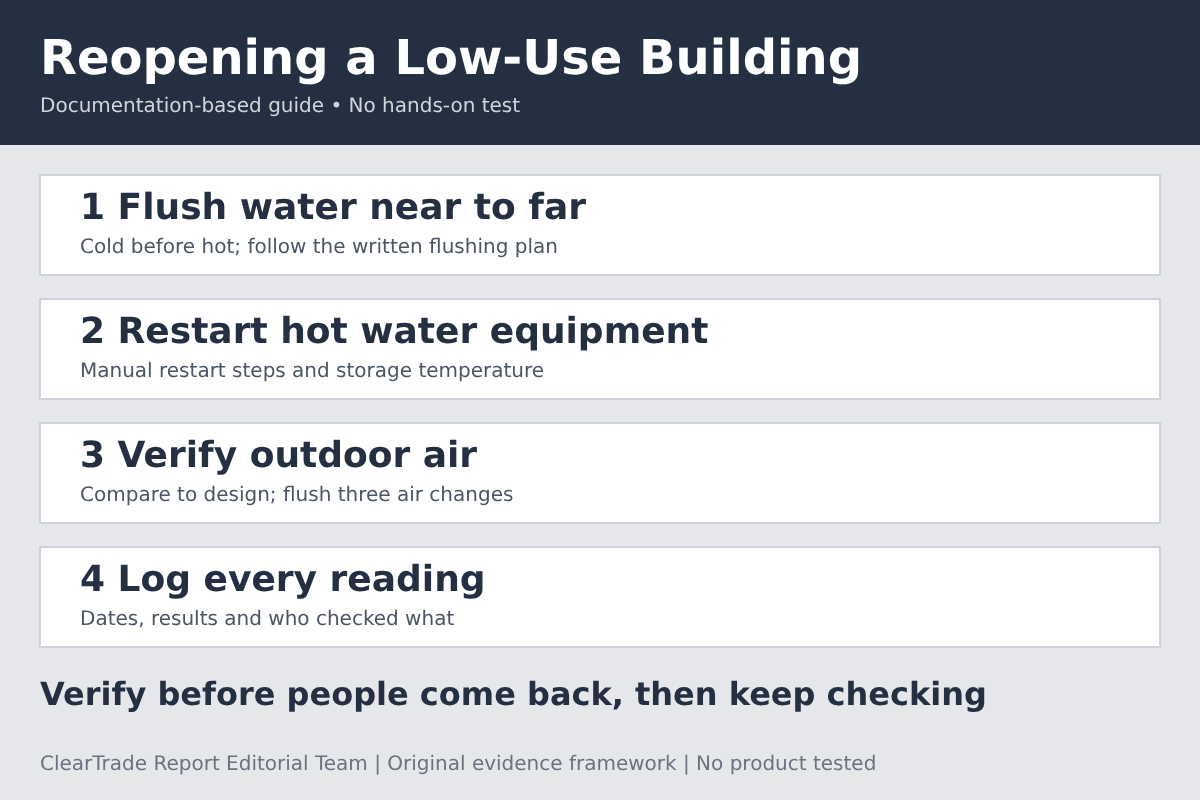
The evidence that best supports a safe return to service after extended vacancy is a written record showing that water was flushed and checked, that hot water equipment was restarted the way its manufacturer says, and that ventilation was inspected and verified before people came back. CDC says a “prolonged period” for Legionella risk may be weeks or months, and that stagnant water can lose its disinfectant. EPA recommends flushing from where water enters the building toward the farthest tap, cold before hot. ASHRAE’s building readiness material calls for inspecting equipment and controls, checking outdoor air against design, and flushing spaces with outdoor air, which ASHRAE describes as a pre- or post-occupancy step. Equipment manuals add their own restart warnings. Keep notes, readings and dates for each step, because that log is what shows the work was done.
Evidence label: Documentation-based guide. ClearTrade Report Editorial Team checked documents from the U.S. Centers for Disease Control and Prevention (CDC), the U.S. Environmental Protection Agency (EPA), ASHRAE, Laars and Fluke on November 16, 2026. No outside professional review was performed and nothing was tested. Companies named are documentation examples, not recommendations. This guide contains no affiliate links.
What low use does to water and air systems
This checklist covers reopening a building, or a floor or suite, after weeks or months of little or no use. It is not an outage or emergency response guide, and it is not a routine maintenance schedule.
Water is the main reason to plan. CDC’s Reopening Buildings Guidance says that for Legionella, “a “prolonged period” may be weeks or months depending on plumbing-specific factors.” It also says “Stagnant water can also lead to low or undetectable levels of disinfectant, such as chlorine.”
EPA’s guide, Maintaining or Restoring Water Quality in Buildings with Low or No Use, lists several effects of stagnation. It says “optimal growth conditions for undesirable pathogens, such as Legionella bacteria, can occur” and “disinfectant residuals (e.g., chlorine) drop to low levels.” It adds that “Water chemistry changes may also increase corrosion and leaching of metals, including lead” and goes on to mention disinfection by-products. EPA’s summary page says closures for weeks or months reduce water usage and that “This water can become unsafe to drink or otherwise use for domestic or commercial purposes.”
Air systems change too. Schedules get cut back, setpoints drift, and filters and dampers sit unchecked. ASHRAE’s Building Readiness document says “When buildings are scheduled for re-occupancy, guidance for re-starting systems is included in this document.” It also cautions that “Actual conditions at any specific building will vary.”
Before you start: plan, utility contact and records
Start with a written plan and a log. Both CDC and EPA point to a water management program. CDC says to “Develop a comprehensive water management program (WMP) for your water system and all devices that use water.” EPA says “Consider developing a water management program for your building water systems and all devices that use water.”
Call the water utility before you flush. EPA’s guide says “Contact your water utility if you have questions on the status of water usage and quality” and suggests you “Coordinate distribution flushing activities with nearby building owners/managers.” That matters when several buildings on the same street reopen at once.
Set up the record before the first valve opens. ASHRAE’s Building Readiness document says to “Set up a log for tracking all adjustments and trends to identify deviations from the program.” ASHRAE’s Guidance for Re-Opening Buildings (September 14, 2021) says to “Create a plan to document the intended operation for the building.” EPA says “Consider documenting all steps taken in the building maintenance records for future reference.”
Think about who does the work. CDC notes that people at higher risk “should consult with a medical provider regarding participation in flushing.” CDC also discusses respirators and says “Respirators must be used in accordance with a comprehensive respiratory protection program.”
Water checklist: flush in the right order
The core water task is replacing stale water in every pipe with fresh water from the main. Use these steps from EPA and CDC as a checklist.
- Start at the service line. EPA says “It is important to flush the service line that runs from the water main to the building.”
- Work from near to far. EPA says “Begin nearest to where water enters the building and move toward the farthest tap.”
- Cold first, then hot. EPA says “Cold water should be flushed before hot water.”
- Reach every outlet. CDC says to “Flush hot and cold water through all points of use (e.g., showers, sink faucets).”
- Run hot water to full temperature. EPA says “Flush the hot water until the water reaches its maximum temperature.” CDC adds: “Where possible, hot water at the tap should reach at or above 120°F.”
- Split large buildings. CDC says “Flushing may need to occur in segments (e.g., floors, individual rooms) due to facility size and water pressure.”
- Limit spray. CDC says “Care should be taken to minimize splashing and aerosol generation during flushing.”
ASHRAE agrees on the basic point. Its Guidance for Re-Opening Buildings says “In general, building water systems should be flushed before they are reopened.” It points readers to “ASHRAE Standard 188-2018, Legionellosis: Risk Management for Building Water Systems.”
Record the time, the outlets flushed and any readings. EPA says “Consider checking water quality parameters, such as temperature, pH, and disinfectant levels,” and that “Achieving stable temperature, pH, or disinfectant levels can be a good indicator” of the flush.
Water heaters and water-using devices
Water heaters. Read the manual before restart. CDC says “Determine if your manufacturer recommends draining the water heater after a prolonged period of disuse.” EPA says to “Drain and clean water storage facilities and hot water heaters following the manufacturer’s instructions.” On temperature, CDC says “Make sure that your water heater is set to at least 140°F.” It adds: “Higher temperatures can further reduce the risk of Legionella growth, but ensure that you take measures to prevent scalding.” ASHRAE’s Building Readiness document says “Keep water above 140°F to avoid microbial incursion” and “Do not let it drop below 120°F.”
Manuals can include restart hazards that general guidance does not. The Laars LUHE120T commercial gas water heater installation and operation manual warns that “Hydrogen gas can be produced in an operating water heater that has not had water drawn from the tank” “for a long period of time (generally two weeks or more).” It says “we recommend a hot water faucet to be open for several minutes” “before you use any electrical appliance which is connected to the hot water system.” The same manual says “DO NOT operate this water heater without first being certain it is filled with water” and that the heater “must be protected from freezing downdrafts during shutdown periods.” Look for a similar section in the manual for your own equipment.
Ice machines and other devices. CDC says “Other water-using devices, such as ice machines, may require additional cleaning steps” and to “Follow water-using device manufacturers’ instructions.” EPA gives “discarding ice” as an example and says “Consult the device manufacturer’s maintenance instructions.”
Filters and treatment. EPA says to “Maintain any water treatment systems used in the building, such as any point-of-entry or point-of-use filters or water softeners.”
Decorative fountains. CDC says to “Clean all decorative water features, such as fountains.” It adds: “After the water feature has been re-filled, measure disinfectant levels to ensure that the water is safe for use.”
Hot tubs and spas. CDC says “Perform a hot tub/spa disinfection procedure before use.”
Cooling towers. CDC says to “Ensure cooling towers are clean and well-maintained” and “Ensure that the tower and basin are free of visible slime, debris, and biofilm before use.” It says “If the tower appears well-maintained, perform an online disinfection procedure.”
Safety equipment. CDC lists “fire sprinkler systems, eye wash stations, and safety showers” among the equipment to address according to manufacturers’ specifications.
Air checklist: inspect, verify and flush
ASHRAE’s reopening documents were written during the COVID-19 period, so parts of them focus on infectious particles. The equipment checks still give a useful structure for any return to service.
- Inspect first. ASHRAE’s Guidance for Re-Opening Buildings says to “Inspect equipment, systems, and controls to check for existing issues.”
- Check controls. The Building Readiness document says to “Check control system and devices for evidence of improper operation.” For calibration, it points to “ASHRAE Guideline 11-2018 -Field Testing of HVAC Control Components.”
- Verify sensors. It says to “Start with verifying critical sensors, such as CO2 or airflow measuring stations.”
- Check dampers. It lists “Control Dampers (check they are functioning and that the positions seem correct).”
- Check filters. It says to “Check for particulate accumulation on filters, replace filter as needed.” The reopening guidance says to “Make note of existing filters’ MERV rating.”
- Check coils and piping. It says “Please follow the appropriate maintenance procedures for coils” and to “Check for proper fluid flow and for fluid leaks.”
- Verify outdoor air. The reopening guidance says to “Evaluate outdoor air ventilation for compliance with design requirements” and to “Confirm systems provide required minimum amounts of outdoor air for ventilation.” The Building Readiness document says, for supply airflow, “measure it directly if possible.”
Flush the space with outdoor air. ASHRAE’s reopening guidance says to “Flush space or building for a time required to achieve three air changes of outdoor air.” ASHRAE’s August 18, 2020 news release says “For a well-mixed space, this would require three air changes of building volume based on outside air cfm.” It also says the guide helps determine if your energy wheel “is well designed and/or well maintained and whether it should remain in operation.”
Humidity. The Building Readiness document says “maintaining the space relative humidity between 40% and 60% decreases the bio-burden of infectious particles.” Spot readings help confirm what the building automation system reports. As a documentation example, Fluke’s 971 product page describes a handheld meter that reads “Relative humidity from 5% to 95%” and “Measures dew point and wet bulb temperatures.” Any calibrated instrument suited to the task can serve the same role.
Return-to-service evidence table
| System | Step | Evidence to keep | Source |
|---|---|---|---|
| Planning | Water management program; utility contact | Written plan, utility call notes, flushing schedule | CDC; EPA |
| Service line and piping | Flush from entry point to farthest tap, cold before hot | Outlet list, times, temperature, pH and disinfectant readings | EPA; CDC |
| Hot water | Follow manual on draining; setpoint at least 140°F; tap at or above 120°F where possible | Manual section used, setpoint, tap temperatures, scald controls | CDC; EPA; ASHRAE; Laars manual |
| Ice machines and treatment | Clean per manufacturer; discard ice; maintain filters | Service record, filter change dates | CDC; EPA |
| Fountains, spas, cooling towers | Clean, check for slime or biofilm, disinfect | Inspection notes, disinfectant readings, contractor reports | CDC |
| Safety equipment | Eyewash stations, safety showers, sprinklers per manufacturer | Flush and inspection records | CDC |
| HVAC controls | Check controls, sensors, dampers; calibrate per ASHRAE Guideline 11 | Calibration sheets, damper position notes | ASHRAE |
| Filters and coils | Inspect, replace filters as needed, record MERV rating | Filter log, coil maintenance record | ASHRAE |
| Outdoor air | Compare to design; flush three air changes of outdoor air (pre- or post-occupancy) | Airflow readings, flush schedule | ASHRAE |
This table is our summary of the cited documents. It is a starting list, not a complete commissioning scope for any building.
After people return: monitor and document
Reopening is not the end of the water work. CDC recommends “regularly checking water quality parameters such as temperature, pH, and disinfectant levels.” It says to “Follow your water management program, document activities, and promptly intervene when unplanned program deviations arise.”
CDC also says “Test your water for lead.” That fits EPA’s warning that stagnation can increase leaching of metals, including lead.
On Legionella sampling, CDC says “All Legionella testing decisions should be made in consultation with facility water management program staff” along with others named on its page. Treat sampling as a program decision, not a single box to tick.
Keep the ASHRAE log running as well, so you can see setpoint changes and drift in the weeks after reopening. For the ongoing program that should follow this one-time restart, see our guide to commercial water management plans and owner coordination.
Know the limits of this guide
This guide summarizes public documents. We did not inspect any building, test any water or measure any airflow. CDC’s page was last reviewed February 6, 2024. EPA’s guide is labeled Version 3 and carries no date on the document itself. ASHRAE’s reopening documents were written for the COVID-19 period, and the Building Readiness file is marked “Updated 5-17-2022.” The Laars manual covers one water heater model and is used only to show the kind of restart warning a manual may contain. Your equipment manuals, your water utility, your local health department and any state or local rules come first. Large or complex buildings, healthcare settings and buildings with cooling towers may need licensed or specialist help.
Primary references checked November 16, 2026: CDC, “Reopening Buildings Guidance” (Control Legionella); EPA, “Information on Maintaining or Restoring Water Quality in Buildings with Low or No Use” (web page); EPA, “Maintaining or Restoring Water Quality in Buildings with Low or No Use,” Version 3 (PDF); ASHRAE, “Guidance for Re-Opening Buildings,” September 14, 2021; ASHRAE Epidemic Task Force, “Building Readiness,” updated May 17, 2022; ASHRAE, “ASHRAE Epidemic Task Force Releases Updated Building Readiness Guide,” news release, August 18, 2020; Laars, LUHE120T High Efficiency Commercial Gas Water Heater Installation and Operation Manual; Fluke, Fluke 971 product page.
Frequently asked questions
How long does a building have to sit empty before these steps matter?
CDC says that for Legionella, a prolonged period may be weeks or months depending on plumbing-specific factors. The Laars water heater manual flags hydrogen gas risk after generally two weeks or more without drawing hot water. Check your own equipment manuals for their thresholds.
Should cold or hot water be flushed first?
EPA says cold water should be flushed before hot water. It also says to begin nearest to where water enters the building and move toward the farthest tap, and to flush hot water until it reaches its maximum temperature.
What water heater temperature do the documents give?
CDC says to make sure the water heater is set to at least 140°F and that hot water at the tap should reach at or above 120°F where possible. CDC also says to take measures to prevent scalding.
How long should ventilation run before people come back?
ASHRAE’s reopening guidance says to flush the space or building for a time required to achieve three air changes of outdoor air. ASHRAE also says to confirm systems provide required minimum amounts of outdoor air for ventilation.
Disclaimer: This guide is general information based on manufacturer, standards and government documents, not professional plumbing, HVAC, public health or legal advice for a specific building or product. Follow your equipment manuals, your water utility, your local health department and any state or local requirements. Rules and ratings may change. AI tools assisted with drafting. ClearTrade Report Editorial Team checked the cited sources and edited this guide.
Need a qualified professional?
Trusted Pros uses visible license-verification states and never ranks paid listings above unpaid listings.