Compare maintenance bids against the same asset list, task requirements, service hours, response milestones, repair allowances and reporting deliverables before comparing annual fees. Record an omission as unresolved rather than assuming it is included. A lower fixed fee can leave more work, cost and coordination with the owner.
This guide is an operational comparison framework for facilities procurement teams. ClearTrade Report Editorial Team reviewed the linked primary sources on October 27, 2026. We did not obtain private vendor proposals, audit a contractor, inspect a building or perform professional testing. The worked price comparison is fictional. This article does not determine whether a contract clause is legally enforceable.
Give every bidder the same starting package
Build a baseline containing the sites, equipment identifiers, quantities, condition information, available manuals, access arrangements and owner priorities. Identify missing records and known defects. Ask bidders to state assumptions about equipment they have not inspected, rather than allowing a generic “all equipment” description to conceal different inventories.
For each asset group, specify the required result and the evidence of completion. Keep the task, frequency or trigger, responsible party and deliverable together. A recurring visit is not, by itself, a definition of the work performed during that visit. Different equipment and operating conditions can require different tasks.
The DOE O&M Best Practices Guide, Release 3.0, dated August 2010, directs readers to manufacturer recommendations and discusses different maintenance-contract structures. It distinguishes broad coverage, labor coverage, preventive maintenance and inspection arrangements, while noting that repair and emergency provisions can vary. This is dated federal-facility guidance, not a current universal contract standard or a guarantee about a vendor using those labels.
Use the exact equipment instructions and applicable project requirements when setting the baseline. Do not turn this comparison checklist into a universal maintenance interval. Our small-commercial maintenance calendar addresses scheduling; the worksheet here addresses what a vendor promises to provide.
Normalize coverage in a comparison table
Place the same question beside every bid. For each answer, retain the proposal page or clarification that supports it. A useful status vocabulary is included, excluded, separately priced or unresolved. Do not replace an unresolved field with a favorable assumption just to produce a total.
| Comparison item | Evidence to request from each bidder | Boundary to make explicit |
|---|---|---|
| Covered assets | Site and equipment schedule with identifiers and quantities | Equipment omitted, newly added or already defective |
| Planned work | Task list, frequency or trigger, qualifications and completion record | Inspection, cleaning, testing and corrective work treated separately |
| Labor and materials | Included labor, consumables, parts and subcontracted services | Caps, deductibles, specialist charges and major replacements |
| Service availability | Covered days, hours, holidays and call-routing process | Availability versus an included attendance or repair charge |
| Extra-work pricing | Rate sheet, minimum billable time, travel and approval process | After-hours premiums, markup and authorization limits |
| Documentation and closeout | Asset-level reports, readings, deficiencies and exportable history | Report deadlines, correction process and handover at contract end |
Avoid treating “full service” as a completed row. Ask which expenses move to the owner when a component fails, when access requires special equipment or when a specialist is needed. Keep quoted limits in their original units: per visit, per repair, per asset and per contract year are different boundaries.
Ask whether the owner must provide access, shutdown coordination, escorts, consumables or preparatory work. Record the cost or staff effort of those responsibilities separately. A contract can shift coordination work without showing that effort in its fixed fee.
Separate acknowledgment, arrival and restoration
For every promised response time, identify the event that starts the clock, the milestone that stops it, applicable service hours and the record used to verify it. “Respond within four hours” is incomplete if one bidder means a telephone acknowledgment and another means a qualified technician on site.
| Milestone | Clarification to obtain | Useful evidence |
|---|---|---|
| Acknowledge | Who receives the request and confirms its priority? | Time-stamped ticket and named contact |
| Dispatch or remote assessment | What action occurs after acknowledgment? | Dispatch record or documented remote findings |
| Attend on site | What qualifications, access and geographic limits apply? | Arrival record linked to the service ticket |
| Stabilize and restore | What constitutes temporary stabilization and final restoration? | Condition report, outstanding parts and completion record |
These are editorial milestone definitions to negotiate, not standard response times. An attendance commitment does not establish a restoration deadline. Ask how parts availability, specialist support, access restrictions and temporary arrangements affect the stated commitment. Keep exceptions visible beside the promise.
For a federal procurement example, FAR Subpart 37.6 requires measurable performance standards and a method of assessing performance in the performance-based service contracts it covers. Section 37.602 emphasizes required results and measurable assessment. That federal scope does not automatically govern a private maintenance agreement; the practical comparison question is whether the proposed service can be measured against its stated result.
A public RFP shows why the attachments matter
The Cosumnes Community Services District HVAC RFP DA-27-003, released July 16, 2026, illustrates several distinctions. Its Exhibit A leaves air-filter changing with district staff. Exhibit B calls for inspection reports within seven days of a site visit. The bid form requests service-call and after-hours rates, minimum callout hours, material markup and response information. Its emergency-call section requests applicable days, hours and expected response time.
Those details matter more than the broad maintenance-and-repair title. An owner comparing another proposal could otherwise assume filter changes are included, overlook a callout minimum or fail to request the report needed to verify work. This is an illustration from a particular public solicitation whose stated proposal deadline has passed, not an open opportunity, an awarded contract or a rule for other owners. We did not review submitted vendor bids or establish the final award terms.
Compare a stated service scenario, not just the annual fee
First resolve whether the planned-work scopes are equivalent. Then ask each bidder to price the same illustrative service scenarios using its stated terms. Keep actual historical call data separate from assumptions; scenarios explore exposure and do not predict failures.
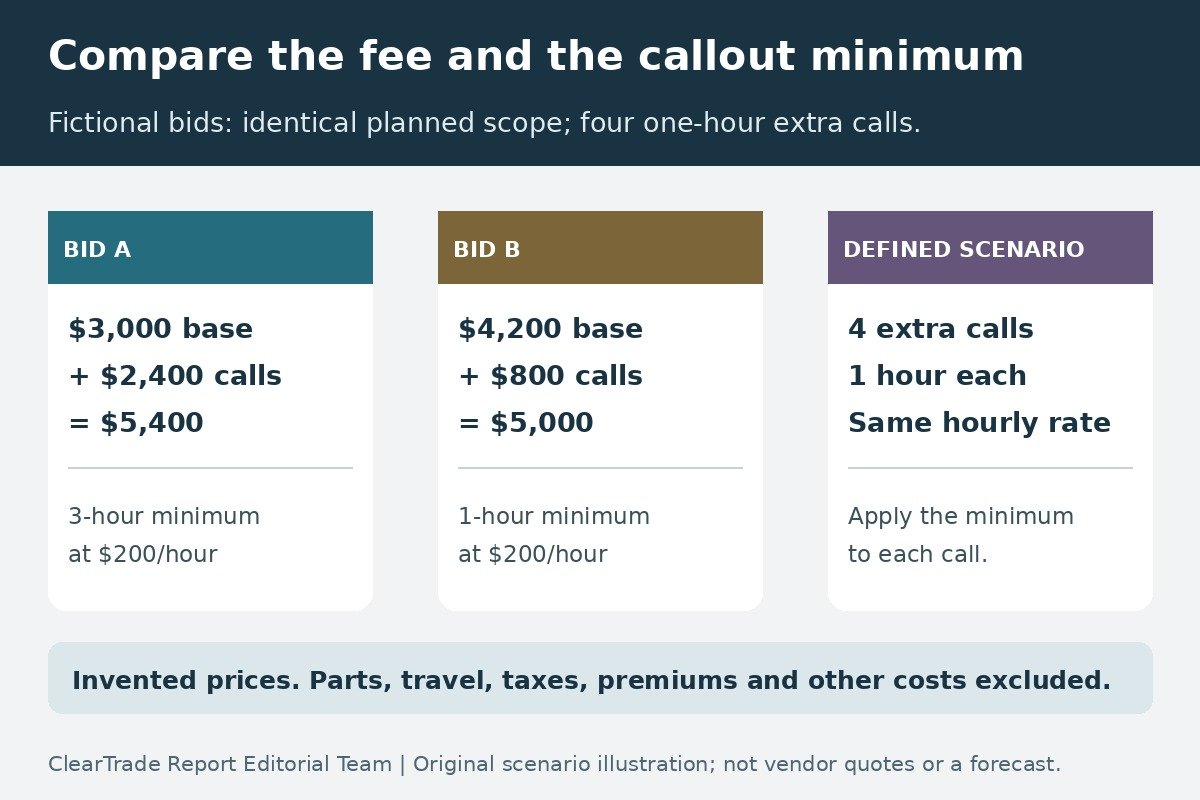
Here is a fictional comparison. Assume the two bids cover identical planned maintenance, charge $200 per hour for the same category of routine extra service, and have the minimum callout terms below. Each of four hypothetical calls requires one hour on site. Assume the minimum applies separately to each call, no calls are bundled, and there are no other charges within this simplified scenario.
| Fictional item | Bid A | Bid B |
|---|---|---|
| Annual planned-maintenance fee | $3,000 | $4,200 |
| Minimum charged per routine extra call | 3 hours | 1 hour |
| Routine extra-service rate | $200/hour | $200/hour |
| Four one-hour calls, applying each minimum | 4 × 3 × $200 = $2,400 | 4 × 1 × $200 = $800 |
| Fee plus those four calls | $5,400 | $5,000 |
With no extra calls, A has the lower fee. With the four calls defined here, B has the lower calculated total. Neither result identifies the better real contract. All names, prices and quantities are invented; these are not market quotes, a forecast or an expected annual cost.
The example omits parts, taxes, travel, premiums, exclusions, escalation and every other cost not explicitly modeled. A real comparison should state how each applies. Do not add a repair allowance to a fee that already includes the same repair, or compare one bidder’s capped coverage with another bidder’s unlimited-looking description without clarification.
Turn exclusions into named responsibilities
For every exclusion, identify who will arrange the work, approve spending and preserve the resulting records. If no party is named, retain it as an unresolved responsibility. Examples to investigate include major replacements, pre-existing defects, inaccessible equipment, hazardous-material work, specialist inspections, software access and consumables.
Do not assume the same exclusion has the same effect across trades. Record the boundary for the actual system and agreement. Ask which tasks support any equipment warranty requirements and who retains the evidence; this guide has not evaluated an individual OEM warranty or decided warranty eligibility.
For extra work, distinguish an initial diagnosis, temporary measure, proposed repair and authorized completion. Document who can approve which action, how an urgent request is escalated and how the owner receives the cost and schedule implications. Use the organization’s approved purchasing process; this checklist does not grant a vendor spending authority.
Define the evidence delivered after each visit
Request a sample report before selection. A useful sample lets the owner connect a visit to asset identifiers, tasks completed, relevant observations or readings, inaccessible items, deficiencies, proposed follow-up and the person responsible for the next action. Separate a recommendation from an approved repair and a completed repair.
Agree how reports will be delivered, corrected and exported at the end of the agreement. Confirm whether the owner receives usable records rather than only temporary access to a vendor portal. Where a system has separate inspection or testing requirements, identify the actual required record without assuming a general service ticket satisfies them.
Our systems-manual handover checklist explains how records connect equipment, responsibilities and acceptance evidence. Contract reports should fit that existing file rather than becoming an unsearchable stream of invoices.
Before selection, retain one comparison register showing the agreed baseline, each bidder’s exceptions, scenario assumptions, supporting clarifications and unresolved decisions. That record makes the choice reviewable without pretending that a numerical score removes missing scope or operational risk.
For a shower project, compare the complete assembly and verification scope before comparing bids. Our shower waterproofing proposal worksheet applies that document-review approach to substrates, transitions, drain connections and closeout records.
For source-capture equipment, compare the complete documented tool-and-extractor arrangement before optional features. Our HEPA dust extractor selection worksheet separates filter labels, airflow rating conditions, connections and maintenance evidence.
When the decision is whether to keep or replace an asset, carry the priced maintenance scope into a repair-versus-replacement lifecycle-cost worksheet. Compare the same service over the same period and keep uncertain operating and later-repair costs visible.
Frequently asked questions
Does full-service maintenance always include repairs and replacement parts?
Do not assume so. Read the actual covered assets, labor, parts, limits and exclusions. Request written clarification of any broad label that does not identify the included work.
Is a response-time promise the same as a repair deadline?
No. Acknowledgment, dispatch, on-site attendance, stabilization and restoration are different milestones. Identify which milestone the promise covers and how its clock and exceptions are defined.
Should I select the lowest annual maintenance fee?
Compare equivalent scope, service commitments, extra-work pricing and owner responsibilities first. A stated service scenario can expose cost differences, but it is not a prediction or a substitute for resolving missing terms.
What records should a maintenance vendor provide?
Agree the asset-level completion evidence, relevant readings or observations, deficiencies, follow-up actions and delivery deadlines. Confirm how the owner retains and exports those records throughout and after the agreement.
Sources and scope
Sources checked October 27, 2026: DOE O&M Best Practices Guide Release 3.0, August 2010, especially section 3.8 and manufacturer-guidance limitations; current Acquisition.gov FAR Subpart 37.6, displaying FAC 2026-01 effective March 13, 2026; and the Cosumnes DA-27-003 RFP, July 16, 2026, relevant Exhibits A, B and E. Sources are linked above. The worksheets and price scenario are original editorial tools, not mandatory contract forms, legal advice, vendor rankings or a claim that a specific agreement has been professionally reviewed.
AI tools assisted with drafting. ClearTrade Report Editorial Team checked the cited sources and edited this guide. No hands-on inspection or testing was performed.
Need a qualified professional?
Trusted Pros uses visible license-verification states and never ranks paid listings above unpaid listings.