State electricity-price averages are useful context, but they are not the rate your utility will charge for the next kilowatt-hour. For a household project, use the state data to frame the comparison and your actual utility tariff to estimate the bill.
Start by checking the year, customer sector and units. A residential annual average cannot be compared fairly with a commercial rate or one unusually expensive month without explaining the difference.
Read the year and units first
EIA’s Electric Power Annual released October 21, 2026 contains 2025 data. Table 2.10 compares 2025 with 2024 in cents per kilowatt-hour. These selected rows illustrate how to read the table; they are not a national ranking.
| Geography | 2024 residential cents/kWh | 2025 residential cents/kWh | Change |
|---|---|---|---|
| United States | 16.48 | 17.23 | +4.55% |
| Washington | 11.90 | 13.17 | +10.67% |
| Oregon | 14.70 | 15.46 | +5.17% |
| California | 31.97 | 31.35 | −1.94% |
Source: EIA Table 2.10, checked October 27, 2026. The table identifies the values as final. ClearTrade calculated changes as (2025 value ÷ 2024 value − 1) × 100, rounded to two decimal places.
For another state, use the same table and select the residential columns. Do not use the all-sectors column as a household figure.
An average price is not a tariff
EIA calculates average retail electricity prices from utility revenue divided by electricity sold. Its measure includes delivered-electricity costs; EIA explicitly distinguishes it from utility rates. A tariff specifies the charges that apply to a particular customer or service. EIA’s definitions
That distinction matters when adding a new load. A state average can support a broad comparison, but it cannot tell you which rate schedule applies to your account or the price at a particular time of day.
Do not assume a state percentage change means your own bill rose by the same percentage. Your usage and account charges must be checked separately.
Convert cents before multiplying
Suppose a planning example uses 300 kWh and a hypothetical energy rate of 15 cents/kWh:
300 kWh × $0.15/kWh = $45.
That is the energy-charge calculation under the stated assumption. It is not a complete utility quote. Add any applicable charges using the actual tariff, and do not add a fixed charge again if it is already included in the bill being compared.
A common spreadsheet mistake is entering 15 as dollars rather than $0.15. Another is multiplying a power rating in kilowatts by a price per kilowatt-hour without first estimating the energy used. Keep the units visible beside every input.
Compare the change in the bill
For a new appliance, the useful comparison is usually the projected bill with the equipment versus the projected bill without it, using the same period and tariff assumptions.
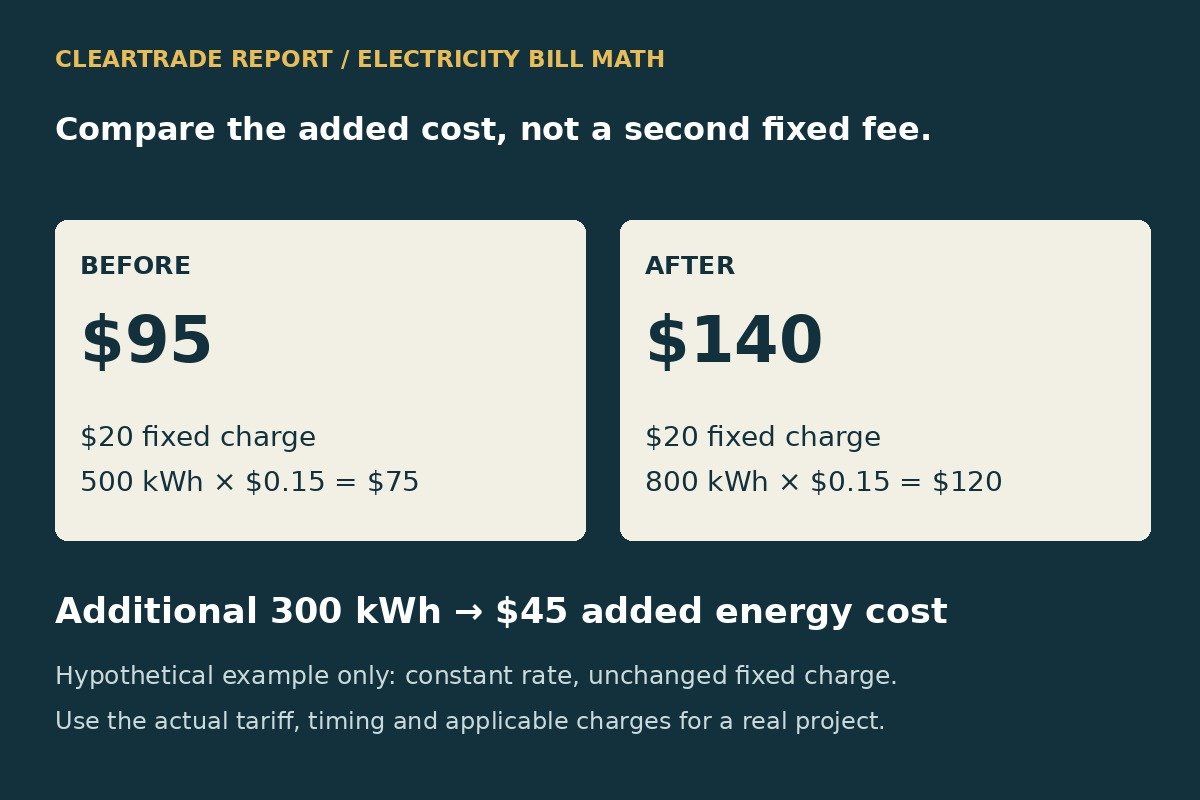
Consider a deliberately simplified example. An existing bill has a $20 fixed charge plus 500 kWh at $0.15/kWh: $95. Add 300 kWh at the same rate, with no other change, and the new bill is $140. The additional cost is $45—not a second $20 fixed charge.
This example is arithmetic, not a real utility plan. If the actual schedule changes, has tiers or time periods, or adds another applicable charge, the calculation must change too.
For time-based pricing, write down when the added energy would be used. Do not use an off-peak rate for all consumption unless the operating plan actually supports that assumption.
Build a useful project estimate
Before accepting a savings estimate for an EV charger, heat pump, solar array or battery, ask for these inputs:
| Input | Question to resolve |
|---|---|
| Current tariff | Which rate schedule and effective date are used? |
| Added or avoided energy | How was the kWh estimate developed? |
| Timing | Does the calculation distinguish relevant pricing periods? |
| Other fuel | Are avoided gas or other fuel costs shown separately? |
| Fixed charges | Which charges remain, and which actually change? |
| Equipment assumptions | What operating conditions and losses are included? |
| Sensitivity | What happens if energy use or rates differ from the estimate? |
This is ClearTrade’s comparison checklist. It does not establish a payback period or recommend a particular technology.
A transparent estimate should let you change an assumption and see the effect. If a proposal gives only a savings total, ask for the calculation. A precise-looking answer is not useful when its inputs are hidden.
Keep comparisons consistent
Use the same data series and comparable periods for year-over-year changes. Label an annual historical comparison as historical. Keep a forecast separate from observed data.
Likewise, distinguish nominal prices from inflation-adjusted analysis. The percentage changes shown here are simple changes in the displayed EIA values; no inflation adjustment has been made.
Next step: Find the rate-schedule identifier on your utility bill and obtain its current terms. Use those terms and an explicit energy estimate for the project, while keeping the state data as background.
Frequently asked questions
Is the state average my utility rate?
No. It summarizes residential electricity revenue per kilowatt-hour across the reported market; your utility tariff determines the charges on your account.
Does a higher price per kWh always mean a higher monthly bill?
No. A bill also depends on how much electricity is used and the applicable charges.
Can I compare a monthly price with an annual average?
You can show both, but label their periods clearly. They do not describe the same measurement window.
Should I use the state average to calculate EV charging costs?
Use your actual tariff and the expected charging energy and timing when available. A state average is only a rough comparison input.
Sources and calculation notes
EIA Electric Power Annual and Table 2.10, released October 21, 2026; EIA electricity-price FAQ. Checked October 27, 2026. Selected examples and hypothetical bills are identified above. No utility-specific rate recommendation or guaranteed savings is offered.
Related planning
For separate reliability measures, see how to read utility outage-duration data. For project funding, see federal home-electrification incentives in 2026; an incentive and an operating-cost estimate answer different questions.
AI tools assisted with drafting. ClearTrade Report Editorial Team checked the cited sources and edited this guide. No hands-on inspection or testing was performed.
Need a qualified professional?
Trusted Pros uses visible license-verification states and never ranks paid listings above unpaid listings.