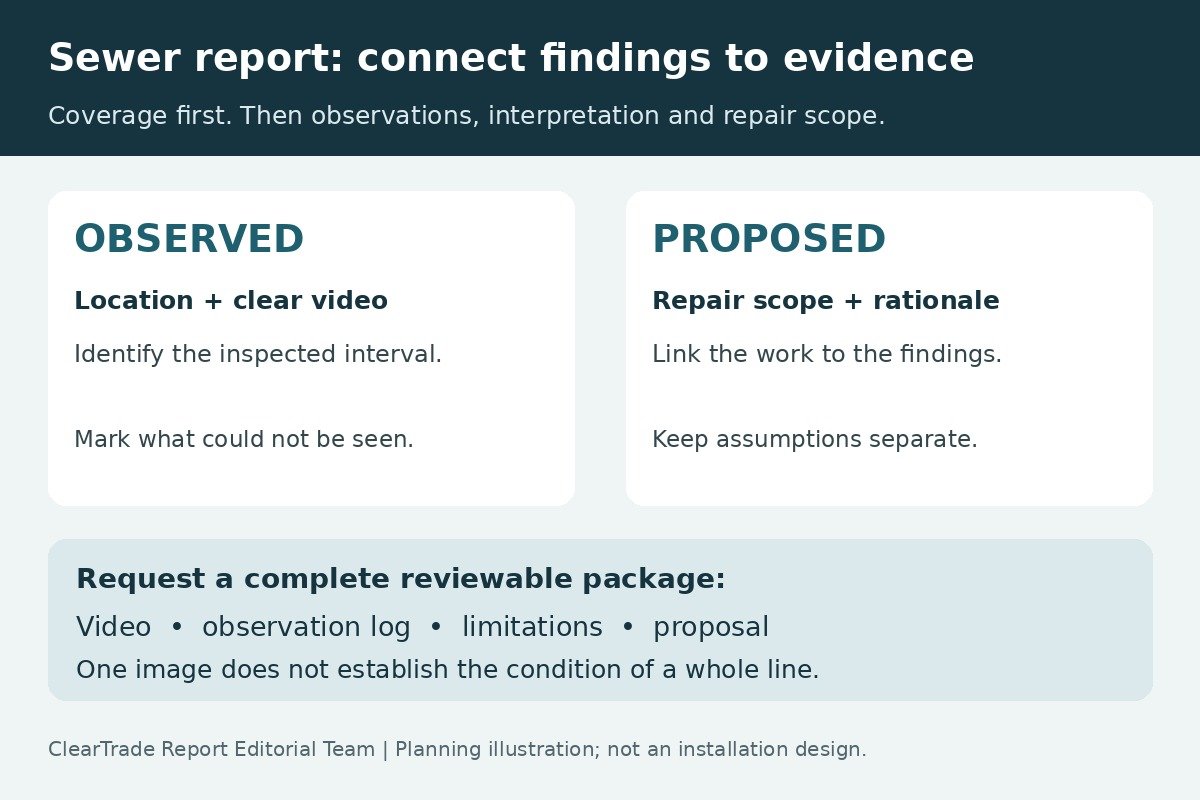
A useful sewer-camera report connects each observation to a location, a clear portion of video and an explanation of what was—and was not—inspected. It should also distinguish an observed condition from the contractor’s proposed response. One alarming still image is not enough to establish the extent, urgency or best method of repair.
This guide helps homebuyers and property owners review an existing inspection and request better evidence. It does not diagnose a particular pipe or choose a repair from a video. ClearTrade Report Editorial Team checked the cited sources October 27, 2026; no field inspection, hands-on test or outside professional review was performed.
Establish what the inspection covered
Start with the route and endpoints. Ask where the camera entered, which direction it traveled, what identified the end of the run and whether the inspector reached the intended connection. Record any branches, shared sections or separate runs that were outside the inspection.
A report saying “75 feet inspected,” for example, needs a defined starting point. That hypothetical distance is not a location on a property map by itself. Ask how the footage counter was referenced and how important observations were tied to the route. Keep measured, located and estimated information distinguishable.
Request the inspection date, operator identity, access point, reported pipe material and size, and relevant conditions during the survey. Where a detail was inferred rather than verified, have the report say so. A complete record can still contain uncertainties; an unexplained blank should not be interpreted as an acceptable condition.
Get the video and an observation log
Seattle Public Utilities’ repair guidance advises customers to obtain written explanations and retain a copy of the inspection video. The city describes the video as useful for later review and comparison. This is a practical records principle, not a guarantee that a video proves a claim or establishes liability.
Ask for the recorded run, an observation log and the written conclusion together. For each reported issue, request a timestamp, distance from the stated access point, description and image or clip that shows the relevant area. Confirm whether the supplied file represents the full recorded run or selected excerpts.
Download an accessible copy where your service agreement permits it; a temporary viewing link can be lost. Verify that the file opens and that its labels match the property and survey before relying on it for another quotation. Keep the original files as received and store later explanations separately so the inspection record remains traceable.
Ask what the camera could not see
Seattle’s guidance notes that a camera cannot see below water in a blocked, non-draining line and that inspection can be more useful after a blockage has been cleared. Ask whether water, debris, poor visibility, access restrictions or an obstruction prevented observation. Have the inspector mark the affected interval and explain whether further assessment is needed.
EPA’s historical condition-assessment report, Appendix A’s CCTV fact sheet, distinguishes a visual view of the interior above the waterline from quantitative information about pipe-wall structure. It also identifies image quality, flow and operator interpretation as influences, and notes that CCTV does not show the supporting soil envelope. We use this as method context, not a current equipment specification.
An incomplete run should be described as incomplete. “Could not pass this point” does not establish the condition of the unviewed length. Likewise, a clear-looking accessible section does not establish that every branch, connection or concealed external condition was examined.
Ask the provider how it would resolve the missing evidence safely. This guide does not instruct owners to open a sewer, enter a confined space, operate cleaning equipment or undertake excavation.
Separate observations, interpretation and recommendations
Read the report in three columns. The observation describes what the inspector recorded. The interpretation explains what that observation may mean. The recommendation proposes a response and should explain why it fits the evidence.
For words such as roots, deposits, cracks, displaced joints or standing water, ask the inspector to identify the supporting segment and describe extent. Do not assume that every use of a familiar term implies the same condition or consequence. If the report uses “belly,” ask what evidence supports that interpretation and what additional assessment, if any, is needed to establish its significance.
Use this worksheet to turn a summary statement into reviewable information:
| Report item | Evidence to request | Question before authorizing work |
|---|---|---|
| Route and coverage | Start/end points, direction and uninspected branches or intervals | Did the survey cover the section relevant to this proposal? |
| Visible observation | Timestamp, footage reference and clear video segment | What exactly was observed, and over what extent? |
| Interpretation | Explanation, confidence and alternative explanations | What remains uncertain or requires another method? |
| Repair recommendation | Method, boundaries, exclusions and rationale | Why does the proposed work match the recorded condition? |
| Completion evidence | Agreed inspections, post-work records and final configuration | How will the owner know the contracted work is complete? |
For a hypothetical report that lists roots at one joint, ask whether the recommendation concerns removing the obstruction, addressing an associated defect, or both. The label alone does not explain why a particular length of pipe is included. This example is a question framework, not a maintenance or repair prescription.
Read condition codes in their proper system
NASSCO describes PACP, LACP and MACP as programs for consistent condition assessment coding of pipelines, laterals and manholes. If a report claims one of these formats or certifications, ask which program, applicable version and survey scope were used. Do not assume that every residential sewer-camera service is a coded assessment under that system.
NASSCO’s grading explanation distinguishes defect severity from overall condition, which also considers how extensively defects occur. A single grade taken out of its report context is therefore an incomplete basis for evaluating the surveyed section.
Ask the provider to explain whether a number represents an observation grade, a section rating or something else. Obtain the plain-language interpretation and its relevance to the proposed work. ClearTrade has not reviewed a paid coding manual, assigned a grade to footage or verified the credentials of any named inspector for this article.
NASSCO’s published quality-control guidance addresses both survey-header information and observation accuracy. That supports asking about data quality as well as imagery. It does not make this owner checklist a substitute for a formal quality-control review.
Compare repair proposals against the same evidence
Request proposals based on the same video, route and list of limitations. Ask each contractor to identify the work limits, proposed method, assumed pipe conditions, access requirements, restoration scope and treatment of connections. Have exclusions and conditions requiring a changed scope stated in writing.
Seattle’s repair overview identifies localized and longer-length repair approaches and notes that contractors may recommend different methods or combinations. That is a reason to ask for a rationale rather than select solely by method name. It does not establish that lining, replacement or any other approach is suitable for your pipe.
For a materially different recommendation, ask what finding drives the difference. Is the contractor addressing the same observed interval, assuming an additional uninspected problem, or including preventive work beyond the documented condition? A comparable quotation should make those distinctions visible.
Keep price allowances separate from confirmed work. This guide supplies no national cost range, remaining-life estimate or savings promise. Before agreeing to a repair, have unresolved technical questions assessed by an appropriately qualified provider who can evaluate the actual site and complete evidence.
Verify responsibility and local requirements separately
The route shown in a video does not, by itself, establish ownership, shared-use obligations or permission to work. Ask the relevant utility and local authority about the service boundary and required approvals. Where a line is shared, identify the parties and records relevant to the proposed work rather than assuming the camera’s entry point settles responsibility.
As a labeled local example, Seattle’s permit guidance distinguishes private side-sewer boundaries from the public-main connection and addresses additional right-of-way permitting. These are Seattle-specific references, not a national ownership rule. Confirm the requirements for the actual location and scope.
Use the authority’s current instructions for work-related permit records and closeout. Do not treat a contractor’s inspection video as a replacement for required approvals.
Agree on the handover before work starts
Ask what records the completed scope will produce: updated route information, the repair interval, post-work video if contracted, applicable inspection receipts, exceptions and maintenance or warranty documents. Have the provider identify which acceptance evidence is required locally and which deliverables are part of your agreement.
Preserve both the original inspection and the completion package. Our building handover checklist offers a structure for keeping system records understandable and accessible. A future reviewer should be able to distinguish the original observation from the work actually performed.
Choosing a handheld camera for cavities and equipment is a separate question from reviewing a sewer report. For that, see our inspection borescope guide to focus distance, view direction and image evidence.
If you are choosing the camera system itself, see our guide to drain inspection camera reel length, sonde frequency and locator compatibility.
Frequently asked questions
Does one sewer-camera image prove the whole line needs replacement?
No. Ask for the full inspection coverage, observation locations, extent and written rationale for the proposed work. One image does not establish the condition of uninspected sections or select a repair method.
What if the camera could not reach the end of the line?
Have the report identify the stopping point, reason and uninspected portion. Ask what further assessment is needed; do not treat the missing footage as evidence of either a sound or failed pipe.
Is a condition grade a repair instruction?
Not by itself. Ask which coding system and rating are being used, what the grade describes and how severity, extent and site conditions support the recommendation.
What should I retain after an inspection?
Keep the original video, coverage and location information, observation log, limitations and written interpretation. Retain repair proposals and completion evidence as separate records linked to that inspection.
Sources and scope
Primary references checked October 27, 2026: Seattle Public Utilities repair and permit guidance; NASSCO program, grading and published quality-control references; EPA’s historical wastewater condition-assessment report, Appendix A CCTV fact sheet. Relevant sections link their sources. Local guidance is labeled; historical methods context is not represented as a current product specification or paid-standard review.
This is a source-led report-review guide, not a property diagnosis, engineering assessment, contractor endorsement or legal determination of responsibility. No outside professional review, inspection or testing was performed. The original ClearTrade Report Editorial Team graphic is an evidence checklist, not documentary sewer footage or a repair design.
AI tools assisted with drafting. ClearTrade Report Editorial Team checked the cited sources and edited this guide. No hands-on inspection or testing was performed.
Need a qualified professional?
Trusted Pros uses visible license-verification states and never ranks paid listings above unpaid listings.