On this page
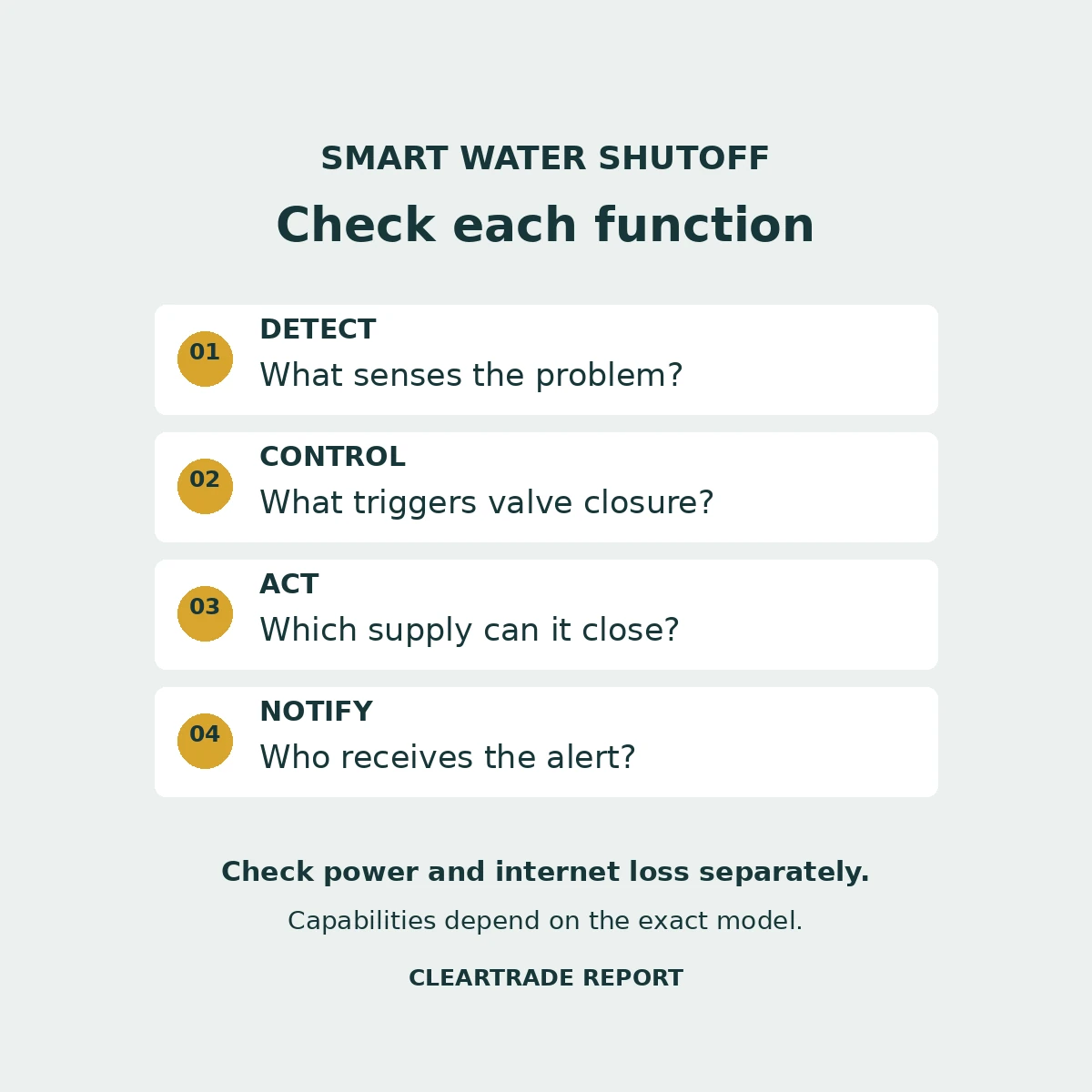
A smart shutoff can interrupt the supply feeding some leaks, but it cannot prevent every water loss. The useful purchase question is not “Does it send an alert?” It is “What detects the problem, what closes the valve, and what happens when power or connectivity fails?”
Treat it as a protection system, not simply another smart-home accessory.
Separate detection from shutoff
A point sensor detects water where its sensing element is placed. A flow monitor evaluates water moving through the monitored supply. A motorized valve can close that supply when the system’s control logic or an authorized user calls for it.
These functions can be combined, but they are not interchangeable. An alert-only sensor does not become an automatic shutoff because both use an app.
Ask the seller to identify the exact hardware and features included in the proposed configuration.
Compare system functions
| Function | What to verify | Limit |
|---|---|---|
| Point sensor | Water must reach its sensing area. | Does not cover every room. |
| Flow monitor | Which supply and usage patterns it monitors. | Does not detect rain entering through a roof. |
| Automatic valve | Which detected events trigger closure. | Stops only the supply it controls. |
| Notification | Who receives which alerts, through what connection. | An alert is not proof of valve closure. |
Define the water-loss problem
Write down the locations and events you want to address. A supply-hose failure, a slow toilet leak and water entering through the roof are different problems.
A device monitoring the main water supply is not a roof-leak detector. A point sensor near an appliance will not detect every leak elsewhere in the building. Useful systems may combine methods, but coverage depends on placement and actual capabilities.
For placement decisions, see ClearTrade’s room-by-room leak-sensor guide.
Verify fit before comparing app features
Have the proposed installer confirm the exact model against the building’s piping and the current manufacturer instructions. Ask about pipe material and size, access, environmental limits, power and the other equipment connected to the supply.
Identify special conditions before purchase: fire sprinklers, wells, irrigation, shared supplies or equipment that depends on continuous water. Do not assume an ordinary residential illustration establishes compatibility.
This guide does not approve a valve location, bypass arrangement or modification to a shared fire-protection supply.
Ask about every failure state
Request written answers for the exact model:
- Does automatic detection and closure work without internet?
- What happens during a power outage?
- Is backup power included, optional or unsupported?
- Can occupants operate the valve locally?
- How are sensor, battery and connectivity failures reported?
- What happens if normal water use is mistaken for a leak?
- How are settings and permissions restored after replacement?
“Works with Wi-Fi” does not answer these questions.
Separate internet loss from electrical power loss. Ask the manufacturer to document detection, automatic closure, local control and remote alerts separately for each condition. A functioning local control does not establish that a phone notification will arrive.
Moen’s Flo support documentation illustrates the distinction: during internet disconnection, some protective shutoff behavior may remain, while cloud alerts and remote control are unavailable. That statement is manufacturer guidance for Flo, not a promise about other products or operation without power.
Plan for ownership
Assign someone to receive alerts and respond. Confirm how occupants, tenants or a caretaker will recognize a shutoff and restore service when appropriate.
Follow the manufacturer’s commissioning and maintenance procedures. Keep the manual, model, installation records and service contact together. A successful app setup does not prove the valve was correctly installed or that every sensor is covered.
Check subscription, cloud-service, account-transfer and privacy terms. Ask what remains functional if a paid service ends. Verify insurer conditions directly rather than assuming a discount or coverage benefit.
Use EPA guidance without confusing it with certification
EPA’s February 2026 WaterSense guide helps compare detection methods and shutoff capabilities; it does not endorse the products pictured or named. It also states that leak-detection and flow-monitoring devices are not eligible for the WaterSense label. Do not mistake a reference in the guide for product certification.
The guide separately points readers to certification under ANSI/CAN/IAPMO Z1349. If a seller claims that certification, verify the exact model and scope with the certification issuer. This article has not verified a named product’s certification.
Treat any insurance discount or utility incentive as a separate check with the provider. Eligibility depends on the program; neither the EPA guide nor this article promises a financial benefit.
Compare complete scope
Compare the installed system: device, required sensors, plumbing work, electrical provision, commissioning, support and ongoing charges. A lower hardware price may omit important parts of that scope.
Do not mistake a product listing or documentation review for hands-on testing. ClearTrade has not tested or ranked products in this article and makes no affiliate recommendation here.
Related reading: water-heater project planning; building maintenance records.
Frequently asked questions
Will a main-line shutoff stop a roof leak?
No. It cannot stop water entering from outside the monitored plumbing supply.
Is a flow monitor the same as a point sensor?
No. One evaluates supply flow; the other detects water at its sensing location.
Does every smart shutoff work during an outage?
Do not assume so. Verify the exact model’s documented power and control behavior.
Who should confirm installation compatibility?
A qualified plumbing professional using current manufacturer instructions; special systems may require additional specialists.
Sources
Checked October 25, 2026.
- EPA WaterSense: Leak Detection and Flow Monitoring Devices — technology overview.
- EPA WaterSense consumer guide, February 2026 — detection/shutoff distinctions.
- Moen Flo installation-document hub — example of model/revision-specific instructions, not an endorsement.
Product-specific compatibility and installation instructions are excluded. EPA guide pages 2–9 and Moen’s Device Offline guidance were checked October 25, 2026. The linked INS11955a page is a revision-specific document landing page, not a universal current manual; Moen also lists INS11955D. The D attachment’s actual contents were not retrieved in this review. Obtain the manual matching the purchased model before installation; no installation specifications are inferred here.
Need a qualified professional?
Trusted Pros uses visible license-verification states and never ranks paid listings above unpaid listings.