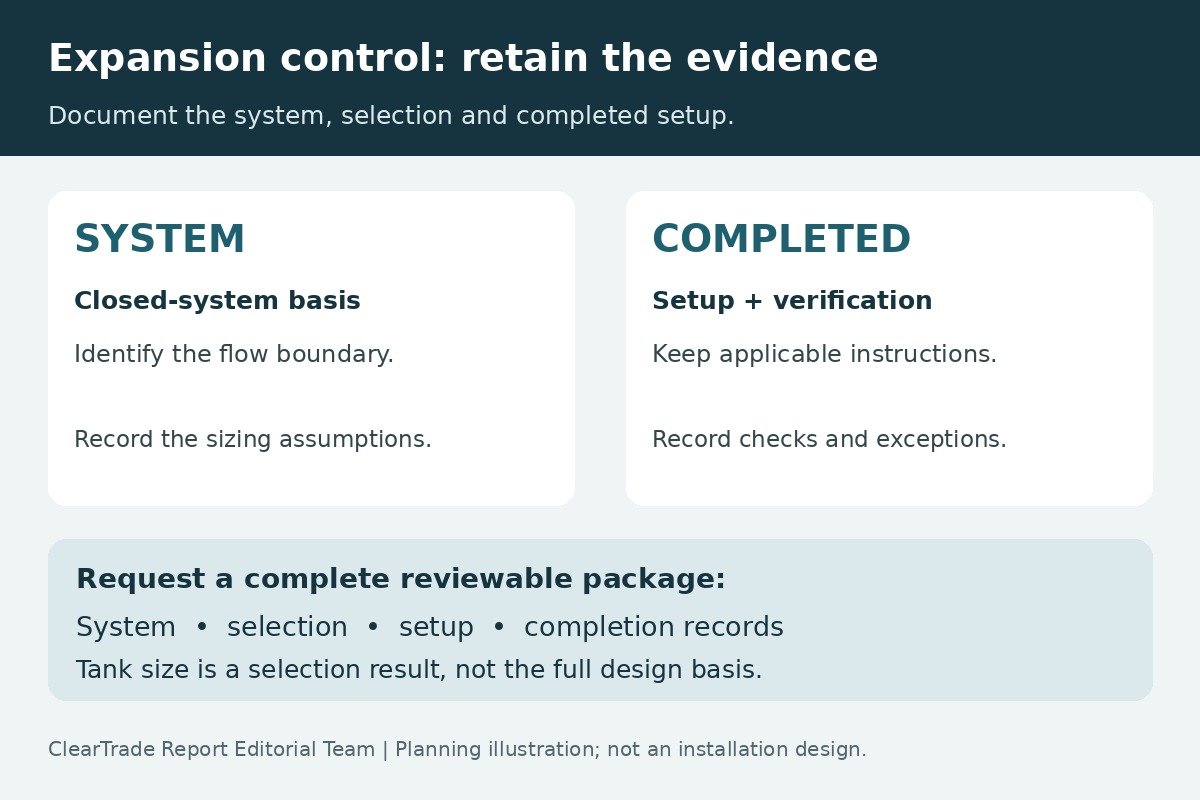
A water-heater expansion tank provides space for the extra water volume created as stored water heats. In a closed supply system, that volume cannot simply move back toward the public supply. A useful replacement proposal should explain the system arrangement, the sizing basis and how the installed control will be checked—not just add a line reading “expansion tank.”
This guide helps homeowners and maintenance teams review that documentation. It is not a tank-sizing calculation, installation procedure or diagnosis of a particular property. ClearTrade Report Editorial Team checked the linked primary references October 27, 2026. No hands-on testing or outside professional review was performed.
Establish why the system is closed
A. O. Smith’s Bulletin 45 explains thermal expansion and identifies check valves and some pressure-reducing valves as possible barriers to reverse flow. It specifically warns against removing those devices to address expansion. The important project question is which actual component and piping arrangement make the heated-water system closed.
Ask the plumber to identify that boundary in the scope or a simple annotated record. Distinguish an observed device from an assumption about what might be inside a meter or valve. If the utility’s equipment is involved, ask how its configuration was confirmed. A photograph of a small tank above the heater does not establish the condition of the entire supply arrangement.
Keep changes in the record. A replaced meter, new backflow device or revised pressure-control arrangement may be relevant to the assessment even when the water heater itself has not changed. Have the provider explain which existing components were considered and which remain unverified. Do not disconnect or bypass them as a homeowner investigation.
Separate supply pressure from thermal expansion
Supply-pressure regulation and accommodating temperature-driven volume change are related but different jobs. The Watts PLT family description identifies expansion accommodation as the tank’s purpose; that does not make an expansion tank a substitute for assessing excessive incoming pressure.
Ask a proposal to state the problem being addressed. Is the provider documenting a closed-system expansion requirement, investigating pressure behavior, replacing a failed component, or doing several things together? A single symptom should not silently stand in for all of those findings.
For an assessment report, request the measurement location, conditions, instrument identification and the provider’s interpretation. A reading without its context is difficult to compare with a later result. Do not infer from a normal-looking snapshot that pressure behavior through a heating cycle has been evaluated. Ask what observation supports the conclusion and what further investigation remains necessary.
This article supplies no universal pressure setting or pass/fail threshold. Have the responsible provider reconcile the heater instructions, expansion-device instructions, other components and applicable local requirements.
Ask for a traceable sizing basis
The owner does not need to reproduce the designer’s calculation to request a usable record. Ask for the selected tank model and the sizing method, including the assumptions that produced the selection. The record should let a later reviewer distinguish entered project information from defaults in a chart or calculator.
Useful questions include which stored-water volume was considered, what pressure and temperature conditions were used, and whether the calculation covers one heater or a connected arrangement. Have the provider identify the applicable manufacturer document and explain how the selected device meets the calculated requirement. A nominal tank label alone is not the calculation.
The Watts PLT installation document separately presents tank volume and acceptance volume, including a pressure-dependent acceptance table. Those labels should not be treated as interchangeable. This article intentionally does not reproduce its numerical sizing tables or select a model for a property.
Where a proposal says “standard size,” ask what makes that size suitable here. If a replacement changes storage capacity or operating assumptions, request confirmation that the earlier selection still applies. Do not use a neighbor’s installation or an online product photograph as the design basis.
Record setup, support and service access
In the linked IS-PLT instructions for PLT-5, PLT-12 and PLT-20, Watts requires qualified installation and service, relates pre-charge to system pressure, and warns against adjusting air charge with the system pressurized. The document also addresses support and potential leakage. These are reasons to request an installation and setup record, not instructions for an owner to adjust a tank.
Ask the installer to record the actual device identification, the applicable instructions, setup information and the basis for the support arrangement. Have the handover explain how service access and possible leakage were addressed. Keep the installer’s documented values distinguishable from factory information printed on packaging.
The reviewed PDF is marked IS-PLT 0932, EDP 2915054, copyright 2009. It remains linked by Watts, but that does not establish it as the latest instruction for every unit supplied today. Obtain the instructions applicable to the exact delivered product. The PDF’s summary and pressure-dependent acceptance tables also contain differing figures; we do not resolve that discrepancy or use them to calculate a selection. Ask Watts or the responsible designer to resolve any numerical conflict before relying on it.
Use a documentation checklist
The following is an original editorial worksheet. It helps organize questions; it is not an inspection certificate or a substitute for technical acceptance.
| Record item | Evidence to request | Question to resolve |
|---|---|---|
| Closed-system basis | Identified devices and relevant piping arrangement | What prevents reverse flow, and how was it verified? |
| Sizing basis | Method, project inputs, assumptions and selected model | Does the selection address this actual system? |
| Setup | Installer’s recorded conditions and applicable instructions | Were factory information and completed settings distinguished? |
| Installation | Support, location, access and leakage provisions | How were the exact product requirements addressed? |
| Completion | Assessment results, exceptions and follow-up record | What was checked, what remains unresolved and who owns it? |
For a hypothetical replacement quote, “tank included” might establish only that equipment is in the price. Ask whether the scope also includes evaluating the existing arrangement, documenting selection, completing setup and retaining the required inspection evidence. This is a scope-comparison example, not a conclusion that any particular bid is incomplete.
Keep the relief valve’s role separate
A. O. Smith’s Bulletin 45 says not to rely on the temperature-and-pressure relief valve for routine expansion control. Its Bulletin 52 describes that valve’s safety role and discusses several leakage or discharge conditions. A leaking valve is therefore a reason for qualified assessment, not proof by itself that an expansion tank is the sole repair needed.
Never plug or cap a safety relief valve or its discharge path. Keep clear of hot discharge and have the condition assessed promptly by a qualified service provider. This guide does not provide a homeowner test involving thermostat changes, opening drains, altering pressure or handling hot water.
When reviewing a service report, ask the provider to separate the observed symptom, the assessed cause and the completed correction. Retain any unresolved finding rather than treating installation of a new tank as proof that every associated issue was resolved.
Confirm the local requirement and retain the handover
As a clearly labeled local example, King County’s water-heater guidance says a closed system needs an expansion tank or another approved thermal-expansion device. That page is not a national rule and does not establish which alternative would be accepted for another jurisdiction or project.
Ask the relevant authority and installer which adopted requirements, approvals and inspection records apply to the actual work. Request that any proposed alternative be identified and its acceptance basis recorded. The presence of a tank in an older installation does not settle current project requirements, and absence from an old photograph does not establish an exemption.
Keep the proposal, sizing record, product identification, applicable instructions, completed setup and inspection evidence together. Our building handover checklist provides a structure for retaining those records and unresolved items. Ask which maintenance instructions apply and who will keep the record current after future heater or supply-system changes.
Sources and limits
Primary sources checked October 27, 2026: A. O. Smith Bulletins 45 and 52; Watts PLT family information and the linked IS-PLT document; King County water-heater guidance. Manufacturer examples explain documentation questions, not a recommended product, verified certification, recall clearance or warranty promise. No paid code or standard was reviewed for this guide, and no site-specific compliance determination was made.
If the complaint is a bang when a fixture or appliance shuts off, keep that event separate from the thermal-expansion assessment. The water-hammer event and service-scope guide explains what to record and how to connect a proposed response to the findings.
A backflow-prevention record answers a different question from expansion-tank sizing. Our backflow test-report guide explains how assembly identity, initial and final results, repairs and provider submission fit together.
Frequently asked questions
Does a pressure-reducing valve replace an expansion tank?
Do not treat the two functions as interchangeable. Have the provider document supply-pressure control separately from accommodating thermal expansion in the actual closed system.
Can I choose tank size from the water heater’s gallon label alone?
Request the applicable sizing method and its full project inputs. A heater label alone does not document the pressure, temperature and system assumptions used for selection.
Does relief-valve dripping prove the expansion tank is bad?
No. Have a qualified provider assess the symptom and document the cause and correction. Do not cap the relief valve or treat a new expansion tank as proof that every issue is resolved.
What should the installer leave with the owner?
Request product identification, the sizing basis, applicable instructions, setup and completion records, inspection evidence where required, and any unresolved items or follow-up responsibilities.
AI tools assisted with drafting. ClearTrade Report Editorial Team checked the cited sources and edited this guide. No hands-on inspection or testing was performed.
Need a qualified professional?
Trusted Pros uses visible license-verification states and never ranks paid listings above unpaid listings.