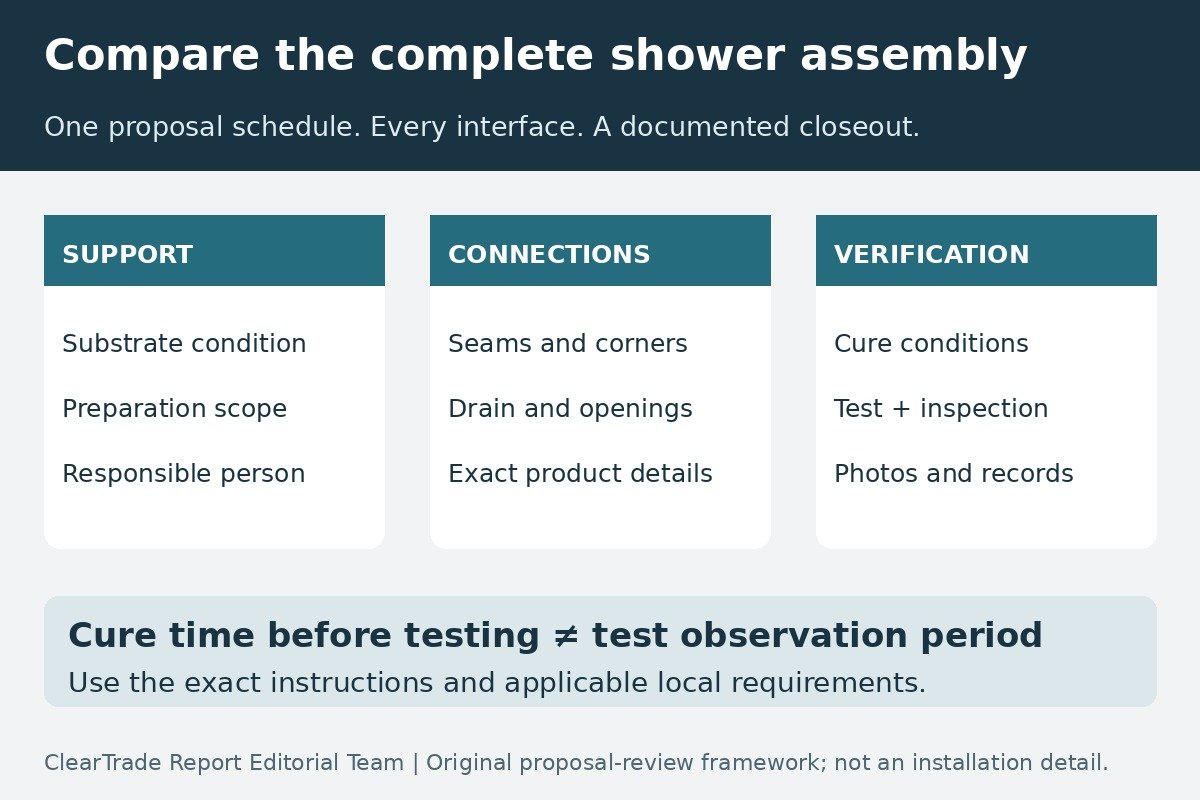
Compare shower waterproofing proposals by the complete assembly: substrate, waterproofing layer, seams, drain connection, penetrations, cure conditions and documented inspection. A membrane brand or attractive tile sample does not identify how all those parts work together. Ask each bidder to put the same details in writing before comparing prices.
This is a documentation-based planning guide for homeowners and remodelers. ClearTrade Report Editorial Team has not installed, flood-tested or professionally reviewed the example systems. Manufacturer references illustrate the documents to request; they are not product rankings, a shopping shortlist or approval of a particular shower.
Start with an assembly schedule
Have the contractor identify the proposed shower footprint, wall construction, base, drain model, waterproofing products and tile finish. Record whether the project includes a curb, a curbless entrance, a bench, niches, a window or steam use. Those features belong in the initial scope, rather than being treated as small accessories after the waterproofing is selected.
The useful comparison unit is one finished, documented shower assembly. A proposal that includes substrate correction, drain adaptation, waterproofing details and a test allowance cannot be compared directly with an allowance for membrane material alone. Request a revised scope where the boundaries differ.
Separate three kinds of authority in the schedule: the locally adopted code and inspection requirements; the selected manufacturer instructions; and the project design or specification. Ask the responsible contractor or designer to resolve conflicts with the manufacturer and local authority before work is concealed. A product page is not a permit approval.
Understand what the system description leaves out
For a bonded sheet membrane, ask which sheet, seam treatment, bonding material, accessories and drain connection are specified. For a liquid membrane, ask which exact formulation, substrate preparation, application checks and cure conditions apply. For a waterproof panel system, ask how board joints, fasteners, edges and connections become part of the waterproof assembly.
These are questions about a proposed design, not a rule that every panel, sheet or liquid uses the same details. The contractor should identify the applicable instructions and drawing for each transition. Do not transfer a detail between products just because the buckets or boards have similar names.
An assembly incorporating a separate shower-pan liner also needs an identifiable wall-to-base arrangement and drain detail. Ask the contractor to show where water is managed in that particular construction. This guide does not provide a generic layer stack or authorize combining a conventional liner detail with a bonded-membrane drain.
| Proposal element | Evidence to request | Unresolved comparison issue |
|---|---|---|
| Substrate and support | Exact board or base, condition assessment and preparation scope | A membrane allowance does not explain repairs beneath it |
| Waterproofing layer | Product name, application and current instruction document | Similar product-family names may describe different formulations |
| Seams and transitions | Project locations cross-referenced to manufacturer details | A waterproof surface does not document its connections |
| Drain and penetrations | Exact components and written interface detail | A drain grate or finish description leaves the waterproof connection unknown |
| Cure and verification | Conditions, timing, responsible person and record format | A calendar allowance alone does not prove readiness |
| Closeout and warranty | Photos, test record, instructions and actual warranty terms | A long warranty label does not explain exclusions or claim duties |
Use this table as a proposal worksheet. Blank cells are requests for information, not automatic findings of defective construction. The person responsible for the assembly should close them before the relevant work proceeds.
Check substrate and transition responsibilities
Ask who evaluates the existing construction after demolition, who approves any changed substrate scope, and how concealed damage changes the price and schedule. A bid can name a waterproofing product accurately while leaving the condition of the supporting construction unpriced.
Mark every transition on a simple project drawing: wall to floor, inside and outside corners, curb or entrance, bench, niche, valve and pipe openings, and drain interface. Request the instruction reference beside each item. Keep the selected mortar, sealant, tape, collar and other specified accessories on the same component list so substitutions remain visible.
For example, the current linked HYDRO BAN installation instructions contain separate substrate, transition, penetration, drain and movement-joint provisions. That makes a generic promise to apply liquid membrane insufficient documentation. The October 2026 document is for HYDRO BAN; its instructions should not silently become instructions for HYDRO BAN XP, Quick Cure or Sheet Membrane. Read the manufacturer instructions.
If a contractor proposes components from different systems, request the exact written compatibility basis and clarify whose warranty applies. Do not assume a mixed assembly is approved or prohibited solely from the number of brand names. Resolve the actual combination, application and responsibility in writing.
Separate cure time from test duration
The waiting period before introducing test water and the period for observing the test are different schedule items. Document both. Also distinguish readiness to set tile from readiness for flood testing; do not assume that one permission establishes the other.
Schluter’s water-test FAQ recommends waiting at least 24 hours after setting KERDI under normal room-temperature curing conditions, with longer waiting in much cooler conditions. Its example describes a typical 24-hour observation period. Those are separate intervals, not a universal one-day allowance for the entire process. Schluter water-test guidance.
The HYDRO BAN instructions DS-663.5-1026 likewise tie flood-test readiness to drying and environmental conditions, including a longer cure allowance at lower temperatures. A short headline about testing speed should not replace the exact instructions. Ask the installer to record the actual conditions and the basis for the planned start time. This guide does not supply a substitute curing schedule.
Before work begins, agree who arranges any required inspection, performs the applicable test, records the observations, investigates a failed result and authorizes covering the work. Ask how a repair will be documented and rechecked. Do not personally improvise drain plugs, temporary dams or test-water loading from an online article; use the responsible installer and applicable requirements.
A test record is evidence of that test under recorded conditions. It does not demonstrate every wall penetration, establish long-term performance or replace the remaining assembly and inspection records.
Keep standards and local code distinct
The TCNA public standards listing identifies A118.10 as a bonded waterproof-membrane material specification and A108.13 as an installation standard for bonded waterproof membranes. These serve different purposes. Ask which applicable standard and project method the proposal references; a material-standard claim alone is not an installation record. TCNA standards listing.
Edition labels also need care. ANSI’s October 14, 2026 overview describes the 2026-07 compilation of tile installation specifications. That compilation date does not mean every component standard was individually revised in 2026. The public TCNA listing still identifies A118.10 as 2023. We used public scope and edition listings, not the purchased full standards, and do not claim a clause-by-clause compliance review. ANSI compilation overview.
For the project location, ask the permit authority which code edition, amendments, inspection sequence and test requirements apply. Do not use another city’s requirements as a national rule. Do not infer project approval from a manufacturer reference to an industry standard.
Steam use and curbless layouts should be declared explicitly. Ask for the assembly documentation that addresses the actual use, including water-vapor requirements where relevant and the entrance or adjacent-floor scope. An ordinary shower proposal should not be treated as proof of suitability for a different application.
Compare two incomplete bids fairly
Consider a fictional comparison. Bid A names a sheet system and includes a drain, while Bid B names a liquid membrane and includes new wall board. Neither describes the existing base or the niche. The difference in total price cannot establish which system is better value because the proposals describe different work.
Send both bidders the same clarification list. Request a complete component schedule, substrate preparation, interface details, verification allowance and closeout package. Then compare exclusions and change-order responsibilities alongside price. These fictional bids illustrate a review method; they are not measured project costs or evidence that one membrane category outperforms another.
| Question before comparison | Written answer needed |
|---|---|
| What does the fixed price include? | Substrate work, components, preparation and finish boundaries |
| Who resolves an unexpected condition? | Named responsibility and change-order process |
| What happens before tile covers the work? | Documentation, test and inspection sequence |
| What is delivered at completion? | Component list, photos, test record, care instructions and warranty documents |
For the wider contract comparison, use our maintenance-bid scope framework to keep inclusions and exclusions visible. Its building-service examples do not specify a shower assembly. For warranty language, the roof-warranty document checklist illustrates issuer, remedy and exclusion questions; its roofing forms do not cover shower materials.
Preserve a usable closeout record
Keep the final component list and the instruction versions used, including approved substitutions. Ask for dated overview and detail photos before the waterproofing is covered, with locations identified on the project drawing. Keep the test and inspection records distinct, including results, any repairs and the disposition of unresolved items.
Retain the actual warranty documents and installer contact information. Clarify who receives a problem report and which records they need. Do not equate a passing test or a brand logo with guaranteed coverage for every failure or replacement cost.
The practical next step is to send the same assembly worksheet to every bidder. If the answers remain incomplete, ask the responsible contractor or designer to resolve the missing detail before selecting on price or concealing the work. This guide supplies a documentation framework, not a construction detail, inspection or diagnosis.
Frequently asked questions
Is a waterproof membrane brand enough to compare proposals?
No. Request the complete component schedule, substrate scope, transition and drain details, verification plan and closeout documents for the proposed assembly.
Is membrane cure time the same as flood-test duration?
No. Cure time governs readiness to begin the test; test duration governs the observation period. Record both using the applicable instructions and local requirements.
Can components from different waterproofing systems be combined?
Do not assume compatibility from similar names or functions. Ask for the written basis for the exact combination, applicable instructions and warranty responsibility before approving a substitution.
Does a passing flood test prove the whole shower is correct?
No. It documents the recorded test under its conditions. Keep the remaining assembly, penetration, inspection and closeout evidence, and resolve any outstanding issues before covering the work.
Sources and scope
Primary sources checked October 27, 2026: Schluter Shower System Handbook, 04/2026 and water-test FAQ; linked HYDRO BAN instructions DS-663.5-1026 and manufacturer product/FAQ context; TCNA public standards listing; ANSI October 14, 2026 compilation overview. No paid standard, individual listing, recall clearance, site inspection, hands-on test or outside professional review is claimed. No affiliate links, manufacturer samples or sponsorship were used in this guide.
AI tools assisted with drafting. ClearTrade Report Editorial Team checked the cited sources and edited this guide. No hands-on inspection or testing was performed.
Need a qualified professional?
Trusted Pros uses visible license-verification states and never ranks paid listings above unpaid listings.