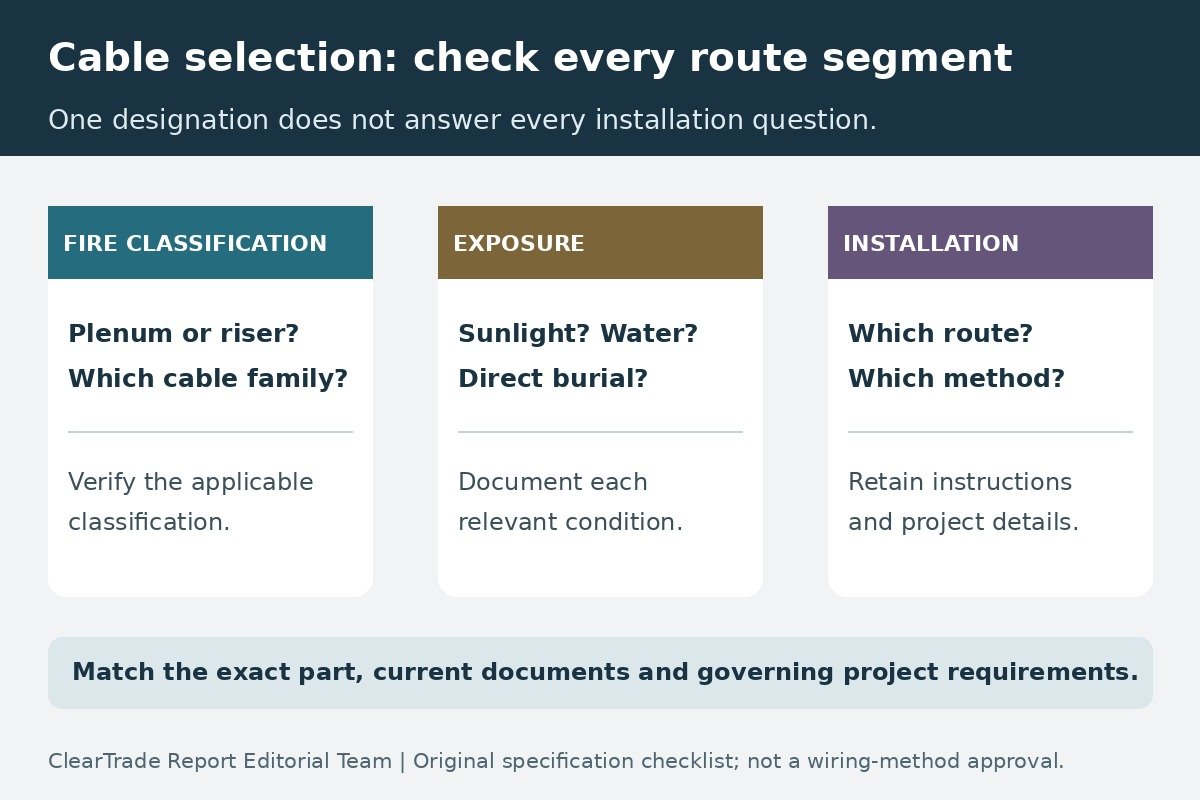
CMP and CMR describe communications-cable classifications associated with different fire-performance applications. Outdoor, sunlight-resistant, wet-location and direct-burial descriptions address other conditions. One label does not answer every question about a cable route.
A cable can carry more than one classification. That makes a combined indoor/outdoor product possible, but it does not turn “plenum” into a synonym for “waterproof” or make any outdoor cable suitable for every indoor space.
For owners and contractors, a useful specification connects the exact cable to every part of the route. This guide shows what to request and how to compare the documents. ClearTrade Report Editorial Team reviewed the cited sources; we did not test cable, approve a design or independently verify a particular reel’s certification.
Start with the route, not the jacket color
Divide the proposed run into meaningful segments: equipment room, ceiling space, vertical pathway, exterior exposure and any underground portion. These are planning labels, not final code classifications. Ask the responsible designer or installer to identify the actual conditions and governing requirements for each segment.
Record whether a ceiling space is used for environmental air rather than deciding from the presence of a suspended ceiling alone. UL’s August 9, 2019 air-handling-spaces explanation distinguishes ducts, plenums and other spaces used for environmental air, and directs readers to the applicable code for the particular product and space.
That distinction matters when a proposal says simply “above ceiling.” Request the space classification and the permitted wiring method. This article does not authorize loose cable in a duct or establish that every dropped ceiling needs the same cable.
Compare the classifications on separate axes
UL explains that a P suffix, including CMP for communications cable, identifies cable meeting the applicable NFPA 262 fire-and-smoke evaluation discussed in its 2019 guidance. Riser products address a different flame-test application; the Belden example below lists UL 1666 Riser.
| Description | Question it helps address | What it does not establish by itself |
|---|---|---|
| CMP / plenum | Is this the applicable communications-cable classification for the identified air-handling route? | Outdoor, wet-location or burial suitability |
| CMR / riser | What riser flame classification is documented for this communications cable? | Permission for every plenum, shaft or outdoor run |
| Sunlight resistant | What evidence supports exposure of the jacket to sunlight? | Wet-location or direct-burial suitability |
| Wet location | What evidence covers the stated water exposure and conditions? | Burial protection or every outdoor installation |
| Direct burial | What evidence covers installation in earth for this exact product? | Every indoor flame requirement or complete trench design |
| Water blocked | What construction limits water travel along the cable? | A substitute for all other required classifications |
The table separates review questions; it is not a cable-substitution chart. Have the project team apply the actual code’s permitted uses, exceptions and wiring methods. Do not infer a universal hierarchy from a sales page.
Outdoor is not one environment
The UL Wire and Cable Application Guide treats outdoor use, sunlight resistance and direct burial as distinct marking topics. Its CMX discussion specifically uses the “Outdoor” qualifier and identifies a dwelling application. Keep the complete designation rather than shortening it to CMX and assuming unrestricted outdoor approval.
The Genesis Outdoor Ratings reference guide, copyright 2023 and hosted by Southwire, separates sunlight resistance, CMX-Outdoor, wet-location, direct-burial and water-blocking features. It describes CMX-Outdoor for one- or two-family dwellings and excludes burial for that classification. Its water-blocking discussion concerns limiting water movement along cable.
For a proposed underground route, request explicit evidence for that route’s exposure instead of accepting “UV jacket” as the answer. Similarly, a water-blocked construction is a useful specification field, not permission to ignore the rest of the route. Conduit, support, entrance, bonding and protection requirements need their own project review.
Read an exact data sheet: Belden 2146A
Belden’s 2146A product page and three-page technical data sheet provide a concrete documentation example. The sheet identifies revision 0.546, dated September 9, 2026.
It describes Category 6, four-pair U/UTP cable, CMR/CMX-Outdoor and a UV-resistant PVC jacket. The environmental field lists indoor/outdoor use, sunlight resistance and aerial use with messenger-wire support. The flame field lists UL 1666 Riser. Installation and operating temperatures are separate fields.
The lesson is how to read the fields together. This sheet’s CMR/CMX description is not a CMP claim, and its separate references to “Plenum Number” and “Non-Plenum Number” are not evidence that 2146A itself carries a CMP classification. Ask for the exact proposed product’s classification, not an adjacent catalog reference.
This is not a purchase recommendation. ClearTrade has not tested the product, verified a supplied reel or established its suitability for a particular building. Keep the exact part number, revision and installation instructions attached to the submittal.
Combined ratings exist; verify the exact product
Belden’s March 21, 2024 indoor/outdoor plenum-cable article describes adding CMP versions to its indoor/outdoor stadium broadcast range. That supports the existence of products intended to address both environments. It does not establish that every CMP cable is outdoor cable.
Treat broad marketing expressions such as “one cable” as the beginning of a document request. Identify the exact part, applicable certifications and conditions. A dual-purpose product still has to match each route segment and its installation method.
If the proposed substitute changes product family, preserve the original submittal and request the replacement’s evidence. A similar diameter, color or category designation is not a complete equivalence review.
Confirm the adopted code and project trigger
Code adoption and a manufacturer’s catalog are different records. As a local illustration, Washington’s WAC 296-46B-010, checked October 27, 2026, references the 2023 NEC and states that the 2026 NEC replaces it effective December 31, 2026. The rule also identifies permit-date triggers and specified exceptions involving building permits or accepted plan review.
That example shows why “latest NEC” is an incomplete project note. Record the jurisdiction, applicable edition, amendments and the date or exception controlling the work. It does not mean Washington’s timeline governs another location, or that a later edition automatically controls an older permit. Our state electrical-code tracker explains the broader verification process.
Ask the project team to cite the applicable requirements for the actual circuit and cable family. Communications, optical-fiber, fire-alarm and other cable designations should not be casually substituted for one another because they share a letter.
A six-row specification review worksheet
Use this original worksheet to compare a proposal against the route. Its purpose is to expose missing information before ordering, not to certify the design.
| Review item | Record to request | Clarification to obtain |
|---|---|---|
| Route classification | Annotated pathway drawing and space descriptions | Which segments need distinct treatment? |
| Governing basis | Jurisdiction, code edition, amendments and project trigger | Which rules and permitted methods apply? |
| Exact cable | Manufacturer, full part number and dated data sheet | Does the proposed item match the submitted item? |
| Fire and environment | Applicable flame classification plus sunlight, wet and burial evidence as relevant | Is each route condition supported separately? |
| Installation limits | Current instructions, temperature fields and mechanical requirements | Which conditions must the installer preserve? |
| Acceptance record | Reel/package identification, as-installed route and required test/inspection documents | What changed, and who accepted the final result? |
Keep “not documented” distinct from “not applicable.” If there is no burial segment, note why burial evidence is not needed. If there is one, an empty field remains an unresolved question.
For transmission-category choices, use our separate Cat6 versus Cat6A guide. For record delivery and labeling, see the structured-cabling handover checklist. Those topics complement environmental selection; a successful network test alone does not fill a missing environmental-classification record.
A worked comparison without approving a cable
Imagine a fictional run from an indoor equipment rack, through a ceiling space and out to an exterior camera. Proposal A says “Cat6 plenum.” Proposal B says “outdoor Cat6.”
Neither description is complete enough to compare. Ask both bidders for the ceiling-space classification, exact cable identity, exterior exposure evidence, applicable entrance detail and governing code basis. Then compare the responses against the same route.
The result may be one documented combined-rated product or a designed transition between appropriate products. This example chooses neither. Its useful output is a consistent set of questions, which prevents a vague label from deciding the specification.
Frequently asked questions
Does plenum-rated mean waterproof?
No. Plenum classification concerns the applicable fire-and-smoke use. Water exposure needs separate documentation for the exact cable and installation conditions.
Is CMR automatically suitable for a plenum space?
Do not assume so. Identify the actual space, applicable code and permitted wiring method, then verify the classification of the proposed cable. A riser designation alone does not establish plenum suitability.
Does sunlight resistance mean direct burial?
No. Sunlight exposure and burial are separate evaluation topics. Request explicit documentation covering the proposed underground installation.
Can one cable be rated for indoor and outdoor use?
Yes, products with combined classifications exist. The exact product and its documentation must still support every route segment and applicable installation requirement.
Sources and editorial scope
Sources checked October 27, 2026: UL’s wire/cable application guide and August 2019 air-handling explanation; Genesis’s copyright-2023 outdoor reference; Belden 2146A revision 0.546 dated September 9, 2026; Belden’s March 2024 combined-cable discussion; and Washington’s named adoption rule.
This is a source-led specification-reading guide. Historical explanatory sources are identified, and Washington is a bounded local example. No complete NEC or test-standard text, independent listing search, product test, professional review, warranty verification or particular installation approval is claimed. No affiliate relationship or buying endorsement is asserted.
AI tools assisted with drafting. ClearTrade Report Editorial Team checked the cited sources and edited this guide. No hands-on inspection or testing was performed.
Need a qualified professional?
Trusted Pros uses visible license-verification states and never ranks paid listings above unpaid listings.