Net metering commonly credits exported electricity in kilowatt-hours that can offset eligible consumption. Net billing commonly assigns exports a separate monetary value while charging for imports under the applicable retail tariff. The name on a solar proposal is only a starting point: read the actual netting period, export price, credit restrictions and settlement rules before estimating savings.
This guide helps solar buyers and property owners review the billing assumptions in a proposal. ClearTrade Report Editorial Team checked the linked primary sources on October 27, 2026. The PG&E discussion is a California utility example, not a nationwide tariff description. The arithmetic example is invented; no customer account, interval dataset or solar system was tested or modeled.
Separate three electricity flows
Electricity generated and used on site, electricity exported to the grid, and electricity imported from the grid have different roles in a bill calculation. A generation estimate alone does not identify all three. Ask whether a proposal includes a load profile and whether its time steps match the relevant metering and pricing rules.
The federal laboratory overview of distributed-generation compensation mechanisms distinguishes net energy metering, net billing and buy-all/sell-all arrangements. In its net-metering description, export credits are denominated in kWh and may offset eligible consumption in the current or later billing cycles. In net billing, exports receive a sell-rate credit; generation consumed on site can reduce purchases. Buy-all/sell-all treats all generation as sales and supplies the site load through purchases.
Use those definitions to ask better questions, then return to the utility documents. A program name does not tell you whether a credit expires, offsets every charge or becomes a cash payment. An annual production total also does not show when exports and imports occur.
Establish which documents apply to the account
Start with the utility, electricity supplier, customer class and service address. Obtain the current retail rate schedule, export or net-metering tariff, interconnection terms, relevant commission order and any program-specific credit schedule. Record effective dates and the date you checked them. A marketing summary can explain a bill, but the applicable tariff supplies the terms to verify.
Ask for the account-specific application or enrollment date, permission-to-operate date and any transition notice. Do not assume a nearby system has the same terms because it uses similar panels. If a property has a separate generation supplier or community-choice provider, identify which entity calculates each component of the bill and export credit.
Keep an unresolved eligibility question open in the proposal review. Request written confirmation from the responsible utility or provider rather than converting a general webpage into an account determination. This article does not decide legacy eligibility, transfer rights or permission to interconnect a particular system.
Read the export tariff with a worksheet
Save a copy of the documents used in the estimate. The worksheet below is an editorial review framework, not a statement that every utility offers each feature.
| Question | Evidence to retain | Assumption to challenge |
|---|---|---|
| What is being netted? | Import/export measurement and netting interval | Annual generation can simply be subtracted from annual load |
| How are imports priced? | Retail schedule, time periods and applicable customer class | A statewide average is the account rate |
| How are exports priced? | Export schedule, time period, vintage and any separate components | Every exported kWh earns the retail purchase price |
| What can credits offset? | Eligible charge categories, exclusions and treatment of adders | A credit reduces every line of the bill |
| What happens at settlement? | Billing cycle, true-up, carryover, expiry and surplus provisions | A banked credit is an unrestricted cash balance |
| Which terms can change? | Effective dates, transition rules and any defined rate schedule term | All prices remain unchanged for the project life |
For a time-varying export schedule, the spreadsheet should connect each export quantity to the correct price period. Keep the unit visible: dollars per kWh and cents per kWh differ by a factor of 100. Also record the timestamp convention, interval length and daylight-saving treatment stated in the applicable documents. Do not silently shift a price table by an hour.
PG&E example: separate the rate schedule from export credits
The California Public Utilities Commission NBT page identifies Decision 22-12-056, adopted December 15, 2022, as establishing the Net Billing Tariff successor to NEM2. It identifies April 15, 2023, as the application-date boundary for the new tariff. Account eligibility and exceptions still require the actual applicable documents.
The current PG&E Schedule NBT PDF calls the program the Solar Billing Plan in customer communications. Its first sheet, effective August 28, 2026, identifies E-ELEC for residential NBT service. The reviewed export-credit provisions value exports using hourly avoided-cost rates and identify application vintage and rate-schedule terms. The billing provisions distinguish generation and delivery credit categories and limit the charges ordinary export credits can offset; ACC Plus credits have different provisions. Check those categories rather than applying one credit indiscriminately to the entire bill.
PG&E customer guidance describes monthly statements and annual true-up. It also links export-credit documents for 2023–2026 and explains that credit values vary with time. Select the account-appropriate schedule; do not take a high-value hour from one table and apply it to every exported kWh. The date of an example statement is not proof that its prices govern a new account.
This example shows why a proposal needs both import and export assumptions. It does not quote a current household import price, promise a savings percentage or determine which schedule applies to the reader.
A two-interval example: surplus energy can coexist with a charge
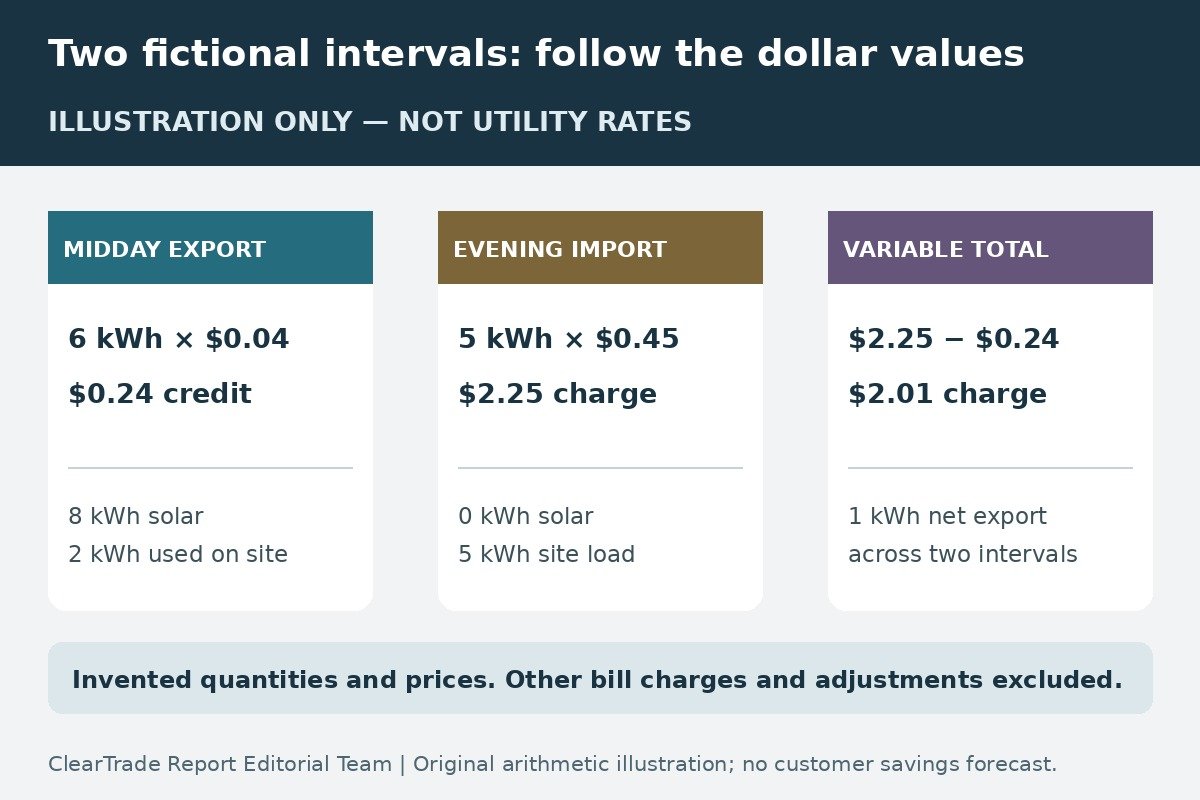
The following two one-hour intervals, energy quantities and prices are entirely fictional. They illustrate separate import charges and export credits under a simple hypothetical net-billing arrangement. They are not PG&E prices, a complete day, actual interval data or a savings forecast. Assume no battery and no other generation, and use each interval as the accounting step solely for this example.
| Fictional interval | Load / solar generation | Grid flow and energy amount |
|---|---|---|
| Midday hour | 2 kWh load / 8 kWh solar | 2 kWh used on site; 6 kWh exported at $0.04/kWh = $0.24 credit |
| Evening hour | 5 kWh load / 0 kWh solar | 5 kWh imported at $0.45/kWh = $2.25 charge |
| Two-interval total | 7 kWh load / 8 kWh solar | 6 kWh exported, 5 kWh imported; $2.25 − $0.24 = $2.01 net variable-energy charge |
The two intervals have 1 kWh more solar generation than load, yet the hypothetical variable-energy balance is a charge. The export and import prices differ. This is why an annual “100% energy offset” claim does not, by itself, establish a zero-dollar bill.
The example excludes fixed charges, taxes, minimum bills, demand charges, credit restrictions, settlement adjustments and every other tariff feature. It also does not calculate the avoided cost of the 2 kWh consumed on site. A real savings estimate needs a defensible comparison bill without the project, the project bill under all applicable terms and separately stated project costs. Do not annualize these two intervals.
Check credit use and annual settlement separately
Track credits earned, credits applied, credits carried forward and any adjustments as separate fields. Ask what a remaining balance represents: kWh, restricted bill credits, surplus compensation or an amount payable under a specific rule. A positive number on an account summary does not answer all of those questions.
The PG&E residential Solar Billing Plan guide, particularly its true-up examples on printed pages 27–28, illustrates separate generation and delivery treatment and a True-Up Credit Adjustment for annual net surplus. It explains that credits already provided for that surplus are recalculated using net-surplus compensation, which may be lower. These are utility illustrations, not ClearTrade customer case studies or current quoted rates.
For any utility, ask the estimator to show how the applicable settlement rules are represented. An hourly export calculation and an annual settlement calculation should reconcile without counting the same exported energy twice.
Ask for a reproducible estimate
Request a model package another person can inspect, with sensitive account details shared only through the provider arrangement you authorize. Useful contents include:
- The applicable tariff and export-price files, with dates and the account eligibility basis.
- Timestamped load and generation inputs, interval units, missing-data treatment and a clear label for measured versus simulated values.
- Import, export and on-site-use calculations, plus any storage assumptions and losses.
- The baseline and proposed bills, with fixed charges, credit limits and annual settlement shown separately.
- Sensitivity cases for changed usage, production and prices, with project financing and incentives stated separately from utility credits.
No customer interval data was available for this article, so it makes no account-level savings or payback claim. Battery economics also require their own cost and operating analysis. A difference between import and export prices alone does not establish that a battery purchase pays for itself.
Our solar-ready electrical planning guide covers physical provisions and coordination. This guide addresses the separate billing evidence. For the limits of broad rate comparisons, see residential electricity prices by state; a state average is not the export tariff for a property.
For an output shortfall, reconcile measurements, dates, forecast assumptions and operating records using the solar production shortfall evidence guide. A bill or export credit alone does not establish the cause.
For a separate comparison of provider payments and continuing obligations, see solar lease, PPA and purchase contract cash flows.
Frequently asked questions
Do net metering and net billing always mean the same thing everywhere?
No. The terms describe common compensation structures, but the applicable utility tariff defines the actual measurement, pricing, credit and settlement rules. Confirm the account and effective documents.
Does producing as much electricity as I use guarantee a zero bill?
No. Timing, import and export prices, eligible credit categories and remaining charges can change the dollar result. Annual kWh totals alone do not establish the complete bill.
Can I use an average retail electricity price for solar exports?
Only if the applicable export rules actually use that value. Obtain the correct export schedule, account vintage and time periods rather than substituting a retail or statewide average.
Are banked export credits the same as cash?
Do not assume so. Check which charges they can offset, whether they carry forward or expire, and how surplus compensation or settlement adjustments apply under the specific program.
Sources and scope
Checked October 27, 2026: federal laboratory Energy Compensation Mechanisms overview; CPUC Net Billing Tariff decision overview; current 48-page PG&E Schedule NBT, including individually dated sheets; PG&E Solar Billing Plan webpage and 55-page residential billing guide. Relevant sources are linked above. This is a tariff-reading framework with one utility example, not a 50-state survey, an interconnection determination, financial advice or a completed customer savings study. Recheck current utility and supplier documents before relying on a proposal; this topic requires quarterly editorial review and earlier review when applicable tariffs change.
AI tools assisted with drafting. ClearTrade Report Editorial Team checked the cited sources and edited this guide. No hands-on inspection or testing was performed.
Need a qualified professional?
Trusted Pros uses visible license-verification states and never ranks paid listings above unpaid listings.