On this page
- Build an asset register first
- Give every scheduled task a basis
- Separate observation from service work
- Use seasons to coordinate, not invent requirements
- Link maintenance to operating evidence
- Keep a manageable weekly view
- For what an annual fire door inspection record should contain, including labels, deficiencies and repair documentation, see our fire door inspection report checklist.Frequently asked questions
- Sources
A useful maintenance calendar starts with the equipment you actually have, the requirements that apply to it and the people authorized to maintain it. Copying a generic monthly checklist is not enough.
For a small building, the objective is straightforward: know what needs attention, why it is due, who owns the task and what evidence shows it was completed.
The workflow below is ClearTrade’s coordination framework, informed by the listed maintenance resources. It does not assign inspection frequencies or authorize specialized work.
Build an asset register first
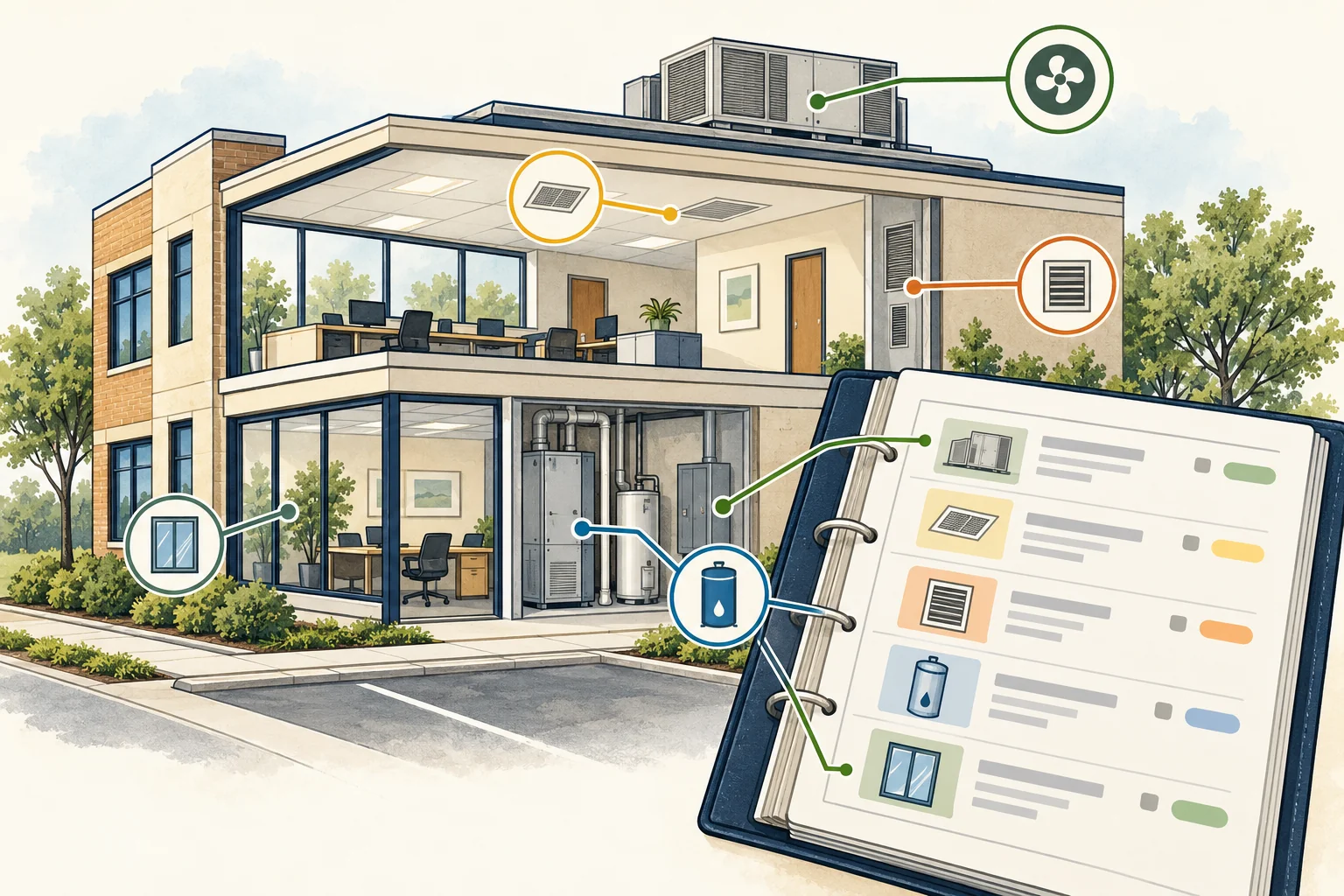
Create one record for each maintainable system or major asset. Include its location, manufacturer, model, identifier, service provider, manuals and importance to building operations.
Do not rely on “the air conditioner on the roof” if there are several similar units. Use identifiers that match service records and labels.
Include assets outside the mechanical room: roof drainage, domestic-water equipment, leak alarms, controls, standby power and other systems the building depends on. Regulated systems such as fire protection or elevators need their own applicable programs and qualified providers.
Give every scheduled task a basis
For each task, record the instruction, requirement or service agreement behind it. Distinguish a legal inspection from manufacturer maintenance and from an owner’s voluntary observation.
When documents appear to conflict, do not choose the easiest interval. Have the responsible qualified party reconcile the governing requirements.
DOE’s Federal Energy Management Program provides maintenance resources and a small-building checklist. Those are useful starting references, not substitutes for the equipment’s instructions or the authority having jurisdiction.
Separate observation from service work
A staff member may be assigned to record a visible leak, an abnormal sound reported by occupants or a blocked access route. That is different from opening electrical equipment, accessing a roof, servicing combustion equipment or testing a life-safety system.
Assign tasks by competence and authorization—not simply to whoever has an empty calendar.
A basic task record should state:
- What is to be observed or serviced.
- Which asset and location it concerns.
- Who is responsible and who is qualified to perform it.
- The governing source and due date.
- The safe access or shutdown coordination required.
- The completion record and follow-up action.
The article is a planning framework, not permission to perform specialized work.
Use seasons to coordinate, not invent requirements
Seasonal planning is useful for arranging access, vendors, occupant notice and budgets. It does not establish a universal maintenance frequency.
Before a heating or cooling season, review the applicable HVAC service schedule and unresolved performance complaints. Before periods of heavy rain or freezing conditions, review the building’s drainage and weather-readiness work with the responsible providers.
For each calendar band, import actual due dates from manuals, inspection programs and contracts. A life-safety task does not become annual merely because an example spreadsheet has an “annual” column.
Link maintenance to operating evidence
Record work orders, technician reports, deficiencies, photographs where appropriate and invoices against the asset. “Vendor visited” is not a useful closeout if the report contains unresolved findings.
Create a follow-up item for a failed test, inaccessible asset, ordered part or deferred repair. Give it an owner and target action. Do not mark the original issue resolved simply because the scheduled visit occurred.
Use trends to ask better questions. Repeated water consumption outside normal occupancy may deserve investigation. A change in energy use can prompt an operational review, but it does not diagnose equipment failure. See ClearTrade’s guide to commercial energy benchmarking metrics.
Keep a manageable weekly view
The asset register can be detailed; the weekly work list should be short. Show what is due, what is overdue, what needs access coordination and what remains unresolved.
Protect time for corrective work. A calendar filled only with inspections can repeatedly document the same defect without getting it fixed.
At a regular management review, reconcile completed work, changed equipment, updated instructions and budget needs. When a tenant, system or service provider changes, update the register rather than starting another disconnected spreadsheet.
Related reading: HVAC filter compatibility; water-leak shutoff planning.
At project handover, use the systems-manual acceptance checklist to connect installed equipment, operating instructions, test evidence, training and unresolved work before translating the accepted information into maintenance tasks.
When procuring outside service, our maintenance-contract bid comparison separates covered assets, response milestones, exclusions and callout minimums. Use it to document which party will perform and report the tasks entered in this calendar.
For buildings with a drainage sump, retain the selected pump curve, basin/control details and commissioning record with the maintenance file. Our sump pump selection guide explains how flow at total dynamic head and the exact control variant support that equipment record.
If the team is moving the calendar into maintenance software, require the proposed workflow and record checks before committing to a subscription. The CMMS selection guide for small facilities connects work-order tasks, user roles, export evidence and ongoing administration responsibilities.
Connect scheduled work and credible equipment failures to the materials needed for recovery. Our critical spare-parts planning guide explains how failure consequence, replacement lead time, usable condition and replenishment rules shape the stock decision.
A building water-management program needs its own assigned responsibilities, technical decisions and review records. Our commercial water-management coordination guide explains what an owner should request beyond a general maintenance calendar.
For what an annual fire door inspection record should contain, including labels, deficiencies and repair documentation, see our fire door inspection report checklist.
Frequently asked questions
Is there one standard maintenance schedule for every small building?
No. Equipment, occupancy, local requirements and operating conditions differ.
Can a generic checklist satisfy legal inspection requirements?
Not by itself. Confirm the applicable inspection and documentation program with the responsible authority or qualified provider.
What belongs in the calendar?
Tasks with an identified asset, basis, responsible role, due date and completion record.
What should I do first?
Build the asset register, attach governing documents and reconcile upcoming work with the providers responsible for each system.
Sources
Checked October 25, 2026.
- DOE/FEMP: Operations and Maintenance in Federal Facilities — current maintenance resource hub.
- PNNL: Small Building O&M Checklist — customizable building-system checklist; example frequency bands are not universal obligations.
- FEMP: Operations and Maintenance Best Practices, Release 3 — historical management framework; not represented as a new 2026 standard.
- EPA: Building Air Quality Guide — historical EPA/NIOSH guide (1991); Section 5 supports responsibilities, manuals, maintenance records and occupant communication. Not a new 2026 standard.
No universal inspection or service interval is prescribed here.
Image disclosure: This article uses an AI-generated editorial illustration.
Need a qualified professional?
Trusted Pros uses visible license-verification states and never ranks paid listings above unpaid listings.